
How do children live in the world of <Roblox>?
27
GG Vol.
25. 12. 10.
You can see the Korean version of this article at: https://www.gamegeneration.or.kr/article/58077160-3aa6-4af8-80e1-6702aff5fb80
I consider the most important goal of education to be helping solve real-world problems. Then, how does that apply to digital media education? We must first listen carefully to children’s actual experiences, try to understand the stories of their world, before hastily deciding on pedagogical implications. From that notion, the platform that we need to pay the most attention in recent days, in the context of digital media and children’s lives, is probably <Roblox>.
According to a 2023 report (Korea Press Foundation, 2023), 90% of elementary school students in Korea were identified to use <Roblox> in some degree. And among teenagers, it ranks just behind YouTube and KakaoTalk, regardless of gender. This staggering number not only indicates the media dominance of <Roblox> but also underscores the significance of this emerging platform, which is practically a “metaverse”-based game platform. And it is used by people of all genders from elementary school through high school. So we must acknowledge that children are not simply playing <Roblox>; They are living in <Roblox>.
From there, “The Children’s Media Usage Research for The Digital Citizenship Education: How Do Children Live in Roblox” research project began with a problem statement that we need a better understanding of our children's digital media usage for a better pedagogical approach to digital citizenship. Including, their experience in <Roblox>. So together with teachers and researchers from the Korea Association of Teachers of Media Literacy (KATOM), we have conducted qualitative research with active and young <Roblox> users. And in this article, we present some of its notable cases to shed light on the true stories of our children in <Roblox>.
<Roblox> - online playground and a small global village
It was during the COVID-19 pandemic that <Roblox> emerged as a key platform for Korean children. It was a time when kids all across the earth were isolated from their friends and the outside world, and thus began gathering in <Roblox> to socialise. But even after the pandemic, <Roblox> remains the most sought-after digital playground for young children in Korea. Why is that so?
We speculate that it may be due to the growing presence of smart devices, followed by the shrinking shared playtime of children in Korea due to increased demands in private education after-school programmes, amid the country’s competitive education environment. Children are also constrained from engaging in physical activity due to rising conflicts between neighbours in mega-apartment complexes (caused by sound pollution from inadequate soundproofing) and the difficulty of finding safe play areas in ultra-urban environments like the Seoul capital area.
All of these factors contributed to pushing children away from real-world playgrounds, instead leading them to escape to online. And there, <Roblox> offered a place where kids could meet and play, even late at night or just for a few minutes. Children can also connect in <Roblox> with friends even after they moved away to a different town or school, or even abroad. Children we spoke to said that simply wandering around <Roblox> with friends online already gives them comfort and a sense of empowerment. Picture cards made by Seohee (11, female), shown below, illustrate her <Roblox> experience as if visiting an amusement park. The feeling of being connected and belonging is perhaps the essence of these kids’ <Roblox> experiences.

In <Roblox>, children are not just interacting with friends and family. They also meet and form new relationships on the platform, sometimes building an entirely new network of people that they’ve never met in real life. Jinhee (12, female) shared how joyful she was when making new friends online through <Roblox>. While playing a simple platformer game via <Roblox>, she teamed up with strangers. They played the game collaboratively and in a friendly manner, encouraging each other as they tried to jump over the obstacles in the game. Even though they didn’t know each other in real life, that shared gameplay experience was more than enough to establish emotional bonding.
Many children have multiple online relationships through <Roblox>. They also perceive the diversity of players and the opportunity to mingle with people in <Roblox> as a positive, beneficial experience. We also had some cases where they said that they prefer playing with foreign players, instead of Koreans, because they tend to wear “cooler looking (in-game) skins” or are relatively more polite and less competitive than some Korean players. Since every communication in <Roblox> can fully be mediated through various body gestures, emotes, VR interactions, and other forms of nonverbal expression in <Roblox>, English proficiency is not necessary. “Skins”, referring to the visual looks of one’s <Roblox> avatar, are also deemed to play an especially important role in online communication. Children we spoke to said they use these skins to express themselves and to read others’ virtual identities. It is generally considered that those who only decorate themselves with free skins might be looked down on by others, often being ignored or even mocked for no real reason. So, in some ways, the world of <Roblox> reflects what it is like in our capitalist real world, where socialising comes with the consumption of products.
Negative experiences on <Roblox>
As we can tell from the free-skin story, experiences in <Roblox> also have downsides, especially when it comes to socialising with strangers in the online space. One of the most common complaints children shared with us was about players with aggressive behaviour. To our surprise, many also claimed that <Roblox> players in Korea are generally more aggressive than others. They said people turn rude or violent during gameplay or while trading virtual items in <Roblox>. There was also a case in which the aggressor followed the kid to continue insulting and vent their anger. Our participants said that such shocking experiences tend to linger in their memories for a long time.

Figure: A picture that illustrates the experience of Minna (10 years old, female), when she was suddenly being insulted while playing <Roblox>.
Generally, young kids seem to ignore such aggressive responses by shutting off the game or walking away, but some choose to fight back. Meaning, they would insult them in return and pass down negative behaviours.
Bullying directly from “Admin” in <Roblox> is also often more direct and aggressive. In <Roblox> and its many Free Admin games, every player can gain administrator privileges. And because the level of admin power is tied to how much “Robux” (currency of <Roblox>) they have, this creates a situation where players with higher-level admin rights abuse their abilities to disrupt other players’ gameplay – killing others or input commands that would manipulate lower-tier’s game experiences. Jaeyoon (11 years old, female) filled the paper full of resonance of unpleasant memories from <Roblox> when asked to draw a mind map titled “My Thoughts on <Roblox>” (figure below). When it came to describing “jump maps”—one of the most popular game types among children—she repeatedly put texts like “too many admins (어드민이 많다)”, “bad admins (나쁜 어드민)”, and “ruining the map so you can’t play (게임을 못하게 맵을 망가트린다)”.

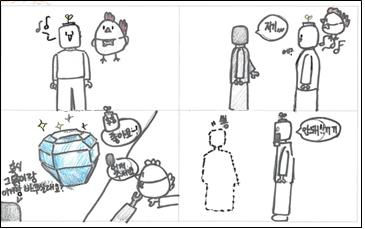
Another shocking experience many children reported to us involved being scammed on <Roblox>. For instance, we can see the word “scamm (사기)” in Jaeyoon’s mind map above. The word also frequently appeared in mind maps from other participants. One of the most frequently mentioned games was “Adopt Me! (입양하세요!)”. One of our participants, Awon (16, female), shared a story from <Roblox> years ago when she was still an elementary student. In the game, she raised a chicken until one day another player approached her, offering to trade it for a valuable item. She agreed, but that player went away – just took the chicken and vanished (see image below). Leaving Awon in shock. Others also wrote “I couldn’t believe it”, “denial of reality”, “sat down and cried (because I) worked so hard in the game”. Scams like this in <Roblox> can instantly wipe out not just a child’s digital belongings but also their time, effort, and emotional attachment that they put in the game.
Life is hard, feat by “Robux”
We think these issues stem from the fact that the world of <Roblox>, where our children live and play, is not free but instead commercially built. It is artificially built spaces of consumerism, perhaps as harsh as the competitive reality that we’re living in right now. <Roblox> operates on a Robux-based virtual economy with no free points or giveaways. In an ideal world, this economy could serve as a healthy training ground where children learn to navigate financial decision-making in digital media without being overexposed to exaggerated commercial advertisements. But in practice, <Roblox> is a world of survival. It is a world where the rich control, often leaving young players (with lesser money to spend in games) vulnerable within the system. Alongside the scams mentioned earlier, we found several repeated keywords from our participants, such as “begging”, “donations”, and even “labour” – things that would never be acceptable if they were happening to children offline, yet online, they are largely unprotected. And because these problems occur between individual players, the company is not obligated to take responsibility in such situations.
One example is the game “PLS DONATE”, a space specifically designed for giving and receiving Robux between players. Children who play without spending real money often earn Robux by completing tasks such as jumping, playing, and responding to commands. They then sometimes donate whatever remains that they manage to earn. Many of the children we interviewed described this as “labour” rather than play. For them, this was anything but fun. Instead, it was doing something meaningless to earn Robux. And even after grinding through these meaningless actions, the payment was not always guaranteed. Hyunsoo (11 years old, female) compared this to, to quote, “working as a construction site worker and not getting paid.” In some cases, kids even resort to begging for Robux, something that can be jarring for non-Roblox-playing adults to hear. But in fact, this is the harsh reality for young players in <Roblox>. In 2021, the United Nations clarified in General Comment No. 25 that children’s rights apply in digital environments just as they do in the real world. However, the status of children's rights and protections in the digital media landscape is still in a dire situation.
Digital citizenship and children's rights online
A quick response of parents and adults on <Roblox> to protect our children is perhaps to block the child’s access to <Roblox>. But it is important to be aware that blocking or banning is not fully able to prevent children from living in the digital world. Instead, we must acknowledge what is happening there, be aware of it, develop practical solutions, and discuss how to navigate these issues more safely. In fact, cutting children off from digital spaces can also be deemed a violation of their right to learn how to use digital media properly and grow up to become media competent. Therefore, we have to acknowledge that diverse experiences, including tryouts and failures, do have a positive impact.
Many of the participating children did not even recognise issues like unpaid labour, discrimination, sexual objectification, commercial exploitation, or verbal abuse as violations of their rights. But through interviews and conversations with our teachers, they began learning how to respond to threats, block malicious users, and protect themselves. Some even returned later to proudly share that they had successfully blocked a problematic player. Ultimately, the children in this research mutually concluded that digital citizenship education could help make <Roblox> a better world. Indeed, the world of <Roblox> is a precious space for them, and they believe it can be protected if everyone cooperates and follows shared values. This is when we need older players, the adults, to help. We are also active users of digital worlds like <Roblox>, perhaps with the power to yield far greater influence on media environments. That is why we believe digital citizenship education isn’t just for children and adolescents—it’s a responsibility for everyone online.
The findings from this research were shared directly with the Roblox Corporation, and our participants’ stories have influenced some of <Roblox>'s new policies. We have also compiled a <Roblox> guidebook for teachers, parents, and children. There has also been some progress in the <Roblox> system, with strengthened reporting systems, and the platform now requires age verification to use chat. While these are pretty important steps, this shouldn’t be the end. To achieve greater digital media safety, we must act and start sharing our children's stories on <Roblox>. We must gain further, more comprehensive knowledge of what is actually happening to our young players and spread those stories to a broader public. We truly believe that greater awareness can shift how we think about game education and help build a healthier environment for children’s digital play. We hope that, with the collective effort of digital citizens, one day <Roblox> can become a safer, more supportive playground for children.
[1] The <Roblox> Digital Citizenship Education Guidebook is available at the KATOM website (katom.me).
Reference
Park Yooshin, Kim Ami, Kim Sejin, Kim Wansoo, Kim Wonyoung, Park Sohyun, Seo Yongri, Yang Chuljin, Ha Yoonyoung, Cha Eunyoung (2023). “The Children’s Media Usage Research for The Digital Citizenship Education: How Do Children Live in Roblox”, Korea Association of Teachers of Media Literacy (KATOM).
Tags:
글이 맘에 드셨다면 공유해보세요.

