
[Contest Winner] The Sovereign Who Deceives the Devil: Sovereign Tower and the Failure of Perfectionism
32
GG Vol.
26. 10. 10.
※ This essay contains spoilers for the true ending of Sovereign Tower.
The moment a save file loads, the world falls briefly silent — and soon returns to the very scene just witnessed. Every mistake I made has become a thing that never happened. Lost items return, dead companions live again, and people repeat the same lines, offering the chance to choose once more. This sensation, like a scene from a time-loop story, is in fact a habit I have repeated beyond counting as I play. I have never quite been able to accept the failure games present me. To me failure was never a delightful accident or a deserved result — only an error to be corrected, a loss to be made whole. Every time a dice roll failed in Baldur’s Gate 3 and denied me what I wanted, every time an unforeseen raid wrecked my settlement in RimWorld, I loaded the latest save until the most perfect, most ideal scenario in my head was complete — even if doing so bent the flow of play out of shape.
To today’s players, none of this is unfamiliar. From the risemara — the “reset marathon” of rerolling a game’s opening endlessly for the best outcome — to the save scumming that tolerates not the slightest loss, we often try to bring the virtual world of a game under control. The perfectionism that refuses failure, gathers every collectible, and drives without deviation toward the true ending and 100% achievements has become a common style of play among players who want to play games “well.” Yet the fact that games hand failure, and the responsibility for it, over to the recipient is an aesthetic property unique to the medium. As the game scholar Jesper Juul observed, games are aesthetic instruments that generate resilience by leading players to suffer the pain of failure within a safe virtual space and to overcome it[1]. The external device of save-and-load, however, leaves room for the irreversibility of failure to be neutralized.
A game is a succession of choices, and their aggregate. Not only games whose grand narratives the player builds directly, like Baldur’s Gate 3 or Detroit: Become Human, but rhythm games and action games — even the seemingly simple Tetris and Pac-Man — demand choice of us continually. Go right or go left; attack or evade; let someone live or let them die. Unlike media such as the novel or the film, most games construct narrative through the player’s active choices and their irreversible consequences. But the expedient of save-and-load, standing outside the game world, neutralizes the gravity of choice. Seen this way, save-and-load strips away the weight peculiar to the medium — responsibility for one’s choices, the acceptance of failure — and leaves only a play of getting the answer right.
Traditionally, save-and-load was an omniscient privilege — a cheat — the player alone could hold. Only the player beyond the screen remembers the failures of the previous run; the world inside the game knows nothing, repeating its appointed lines. But the game Sovereign Tower has drawn the player’s appetite for control, long a trick outside the screen, into the game’s own systems. Sovereign Tower is a text-based role-playing management game in which a nameless wanderer becomes sovereign of the White Tower, left in ruins after the loss of its emperor, and leads the kingdom of Bretannia and the Knights of the Round Table. Run on stat-based choices, this world is hard to predict an inch ahead, and failure comes often. Of such situations we say that spilled water cannot be gathered again. In Sovereign Tower, it can — by “the Devil’s Power.”
The Devil Who Whispers Perfectionism

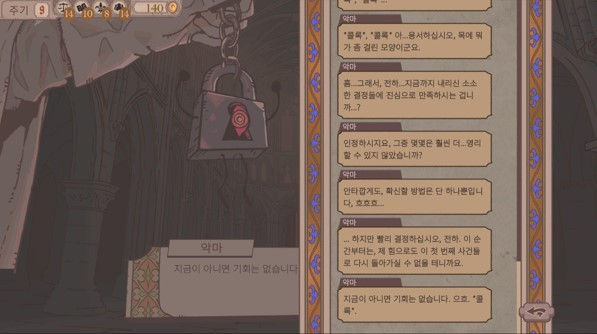
The weight of choice a sovereign bears in Sovereign Tower is not light. The game demands political decisions of the player without pause, and presents their irreversible consequences at once. Errors of judgment, small and large, lead to a cherished knight’s futile death, ruin relations with an allied county for good, send power and reputation tumbling — and push the player into failure’s pit. And at every such moment of despair, the devil lodged in the tower’s crypt stirs the player’s inner perfectionist desire, whispering — suspect, but sweet:
“Call on me, and Your Majesty’s mistakes will vanish like dew in the morning sun…
nor does it carry a price that would end the world.”
The moment “the Devil’s Power” is used, the game world honestly returns to the past cycle the player designates, and everything becomes as if it never was. Even as time rewinds, the sovereign’s knowledge from the previous cycle and the player’s memory are preserved intact, and new options are sometimes unlocked accordingly. A sovereign who knows appointed fates and others’ inner thoughts in advance approaches the position of an all-knowing controller, rearranging the destinies of knights and envoys. And happily, the devil told no lie. “The Devil’s Power” wipes the sovereign’s mistakes clean, and demands no price whatsoever. Only this: the number of uses is recorded in the character codex, and a few characters react — startled, or afraid — sensing something uncanny in the sovereign’s omniscience. These small shifts have no real effect on the actual running of the realm.

In the ordinary game, saving and loading is a free systemic license that winks at the player’s failures; Sovereign Tower has implemented save-and-load itself as a transaction with an other — the devil. The moment this expedient from outside the game, once the player’s exclusive territory, steps inside, save-and-load ceases to be harmless system manipulation and transmutes into an ethical contract with a devil. And Sovereign Tower’s “Devil’s Power” system is no mere narrative wrapping for a save-load function. It reduces the player’s conduct to data objects open to efficient control, fundamentally reorganizing how choices, consequences, and rewards within the game are approached. The player is no longer one who endures choices, but one who can delete failures and cull only the better picks.
The important point is that the moment save-and-load appears openly as a system, the player’s threshold for enduring failure drops lower still. It becomes, quite literally, the devil’s temptation. Within a management system ruled by rational calculation and profit-and-loss appraisal, the player armed with the weapon of memory arrives at a state of being unable to bear not only vast tragedies like the realm’s extinction, but the most trivial loss. One cannot stand even an NPC’s faintest reaction to a chosen option, and the hand reaches out to deal with the devil. In the end, the “Devil’s Power” of Sovereign Tower operates less as a hero’s authority to save the world as its ruler than as a system faithfully serving the player’s micro-desire for control — the refusal, on management’s cold board of numbers, to concede a single grain of loss. Is the game, then, encouraging the player to rewind time at will?
A Game That Teaches Failure
Attempts to present out-of-game acts like save-and-load as meta-level systems, as “the Devil’s Power” does, have always existed. There are cases that needle and scold the act itself, like Flowey in Undertale or Mr. Resetti in the Animal Crossing series; and there are cases that carry save-and-load into the heart of the narrative as a time-rewinding superpower, like Max in Life Is Strange. In Life Is Strange in particular, rewind too far and Max pays a bodily price — headaches, nosebleeds, fainting — and even the order of reality comes loose in a tragic butterfly effect. Such devices exist, we may say, to leave the player a message: play honestly rather than lean on the expedient — in other words, accept failure as it is.
Sovereign Tower’s way of intervening with the player runs on the same track. The game’s position shows plainly in its true ending. To see it, first of all, one must not use “the Devil’s Power.” Only the player who shakes off the devil’s temptation and stacks careful choices moment by moment reaches the ending held to be the game’s “real” story. In that ending’s story, moreover, the sovereign drives the “Golden Key” into the devil — who takes the form of a lock — and annihilates him utterly. The game marks “the Devil’s Power” not as a temptation merely to be let pass, but as a thing to be executed in the end. This reveals that the game still counts save-and-load a negative — something to be forsworn. A true gamer must accept even failure: to this message, which other games have long shouted, Sovereign Tower adds its weight as well — while tempting the player’s perfectionism to their face, with a devil for its mouthpiece.

This didactic message sharpens further in the game’s “Sovereign Mode.” At each new game, the player is asked whether to activate it. Sovereign Mode disables manual saving and blocks save and load in the menu — this game’s challenge mode, its hard mode. Play in Sovereign Mode and wish to take a choice back, and “the Devil’s Power” is the only way. In this light, the gravity of choice and the trial of conscience the game intended in “the Devil’s Power” operate fully only within Sovereign Mode’s constraint.
The System’s Back Door, Left Open
But the moment the game gives the player the option of declining Sovereign Mode, the message it meant to deliver is easily disarmed. Outside that mode, save-and-load of one’s own — through manual saving — is possible at will, without passing the devil. The player’s obstinate perfectionism, to dodge the ethical guilt “the Devil’s Power” carries, presses ESC and heads for Save and Load — deleting failures without any narrative price, and seizing the perfect ending. The temptation designed to target perfectionism is rendered useless in the hands of the very player who craves a clean, flawless run, and the system’s back door swings open. Here the design of Sovereign Tower and the player’s refusal of failure collide, and a crack runs through.
While players slip in and out of that back door, the lesson about failure the game meant to convey is diluted — and finally even the hierarchy the game sought to build around its true ending is dismantled completely. The true ending one reaches in Sovereign Tower by holding out to the end without once using “the Devil’s Power” looks, at first, like a sublime reward granted to the one who has fully accepted failure’s pain and irreversibility and discharged the sovereign’s heavy duty. For the ending to carry that weight, the ethical virtue of accepted failure along the way must be absolutely secured.

But so long as Sovereign Mode can be declined and manual saving exists, that stern hierarchy shakes at the root from the very start. The players who reach the true ending with a “Devil’s Power” count of zero — are they truly mature sovereigns who bore out their failures and humbly accepted the spilled water? Mostly not. “The Devil’s Power” is a system that rewinds failure — and at the same time a system that records the fact of the rewinding. The perfectionist cannot bear the trace as much as the failure itself. If anything, they transmute into perfectionists more obstinate still, to make the perfect choices the true ending requires: consulting guides each quarter, saving manually again and again, loading the game at each brush with failure. All they meticulously avoid is the system’s circumstantial evidence — the branded use count of “the Devil’s Power.”
In the end, the ethical signpost the true ending erects fails to correct the player — to make them accept failure and relinquish perfectionism. Sovereign Tower carried the message: abandon perfectionism, attend to the weight of choice, accept failure. What actually happened at the player’s fingertips was merely a change in the instrument by which perfectionism is executed. That “the Devil’s Power” went unused proves only that the player did not rewind time; it proves nothing of how failure was experienced. And so this collapsed true ending becomes, paradoxically, no more than a trophy handed to the perfectionists who deceived the devil and slyly swapped failure out of the record.
An Aesthetics of Collision
The devil of the crypt overlaid the power to rewind time with guilt and the brand of the record, and — holding the true ending as collateral — tried to induce the embrace of failure. But rather than obediently follow that ethical signpost, the player chose the detour of manual saving and completed a salvation of their own. I, too, declined the “Sovereign Mode” that would have forced honest failure on me. At every brush with failure I pressed the ESC key, which leaves no trace. When I finally reached the true ending with the clean record of “Devil’s Power uses: 0,” what wrapped around me was not a sovereign’s sublime self-reflection but the sense of achievement at having cleared the true ending — and relief at having dodged the ethical scarlet letter. Even before a system as elaborate as Sovereign Tower, my perfectionism went uncorrected; I remained a sovereign loitering at the back door, in the system’s seams.
Is this save-and-load, then, merely a malicious cheat that sabotages the game’s intent? It is not. The process by which a player erases deviations with manual saves is also, plainly, a part of “play” — occurring within the scope of autonomy and control the medium of the game has granted the player. Mobilizing every rule and every systemic seam the game provides in order to reach the designer’s designated answer — the true ending — is the very way a gamer conquers a world and pursues perfection. As argued above, the manual save is not a rupture of the system but an active compromise forged between the perfectionist player and the game’s systems.
The critical aesthetics Sovereign Tower displays, in the end, does not lie in whether it succeeded in teaching the player the maturity to face failure. Just as Ian Bogost saw a game’s rules and procedures as themselves a rhetorical utterance[2], Sovereign Tower designed its message of accepting failure through procedure — “the Devil’s Power” and the conditions of the true ending. But so long as the detour of manual saving stands open, the procedure cannot point the message home; it remains a message procedurally unindicated. The real value arises at the fissure where the developer’s elaborate normative design and the player’s tenacious desire for control — refusing a single deviation — collide at full force. The game may have failed to deliver its lesson in accepting failure, but it succeeded in sublimating into the most naked spectacle the substance of this singular aesthetic struggle that developer and player wage over rules and initiative.
Before the world’s law that spilled water cannot be regathered, we still sit behind the screen, fingers flashing, ready to turn back the past. If even this appetite for control, this expedient, is one form of play the virtual world of games permits, then perhaps we are already playing — with great precision, on the board the developer has laid — a game of our own, called “perfection.”
[1] Jesper Juul, The Art of Failure: An Essay on the Pain of Playing Video Games, MIT Press, 2013.
[2] Ian Bogost, Persuasive Games: The Expressive Power of Videogames, MIT Press, 2007.
Tags:
"게임비평공모전", "소버린 타워", "세이브 로드", "세이브 스컴", "완벽주의", "절차적 수사학", "이언 보고스트", "예스퍼 율", "Sovereign Tower", "Save Scumming", "Procedural Rhetoric", "Game Save Systems"
글이 맘에 드셨다면 공유해보세요.

Someone who is up for anything, as long as it's fun. Deeply interested in how spaces come into being and disappear, online and off, and in the moments when people gather and scatter within them. Researches subculture and game culture, and plans and runs community projects such as the Subculture Studies Only Event and Game Talk Club.
