Stories Untold: An Interface for Approaching Memory
31
GG Vol.
26. 8. 10.
※ This essay contains partial spoilers for Stories Untold.
1. First, Co-exist with the Interface

How Stories Untold (2017) approaches memory: it is not smooth. The player … approaches memory. What clatters into that ellipsis is the interface. The player is (un)consciously induced to dig into the protagonist’s “memory” — a certain truth wearing memory as its skin — and to do so must be bound to interfaces on two levels. Inside the game one stands shy before the retro analog hardware of the 1980s — CRT monitors, mechanical keyboards, a DOS prompt, measuring instruments, an old radio transceiver — while outside the game, one simultaneously wrestles with the keyboard and mouse needed to control them.
A game’s interface is commonly divided into the internal informational interface — the HUD and information windows (inventory, map, journal, library) — and the external physical interface spanning controller, keyboard, and mouse[1]. What makes Stories Untold distinctive is that these two strata converge upon the reality, and the representation, of the “physical interface,” drawing the player along in that form. Strictly speaking, even the internal informational interface is represented in the form of diegetic physical devices within the game world[2].
The player, that is, holding the fixed physical interface outside the game, must perform the work of operating, by turns, the multilayered physical interfaces represented on the screen. And though the hardware at one’s fingertips is always the same, the interfaces reached inside the virtual screen demand a grammar of operation that shifts from chapter to chapter. The tight structure of coordination between this “double” (physical) interface — which the player must pass through to approach the fragmented memory — forms the skeleton and the signature of this game[3].
What deserves note, though, is that this collaboration between the double interfaces always precedes the memory and the narrative within the game. In a word: the interface always arrives before the memory. In my own play, it was difficult throughout to dwell deeply on the narrative of the game’s fragmented memory-images, or to slip easily into it; one is driven first to adapt to the unhospitable controls layered over the four episodes. (The game is, from the start, an environment with tutorials cut to the extreme.)
The player, then, before ever facing the protagonist’s segmented memories, cannot help but taste being thrown, “first of all,” into an uncomfortable co-existence with the interface(s)[4]. Even the (unskippable) intro replayed before every episode is dominated by images of the game’s interfaces slowly afloat, and the player comes to feel serially indoctrinated(?) into the process of facing the interface — visually, tactilely.
In that respect, I would argue that Stories Untold needs to be read, actively, as a game that takes not the material of memory itself but the very “manner of approaching memory” as the core experience of play. Why does this game not consume memory as an object of easeful immersion, but induce the player endlessly to “input and touch” by way of interfaces inside and outside the game? And why is the passage to witnessing memory established under the precondition, of all things, of the appearance of coarse, retro, analog hardware? Ultimately this essay asks after the principle by which the act of groping through memory — beyond the player’s piecing together of its fragments — has been translated into the physical act of operating a retro interface.
2. Inheriting Hypermediacy: The “Interfacing of Memory”
It is hard, in the end, to shake the impression that a broad premise runs through Stories Untold: make the player conscious of the interface prior to the game world. And to this premise the concept of hypermediacy connects without difficulty. To sketch the concept: hypermediacy is a representational strategy that thrusts the medium’s existence to the fore, making the user conscious of passing by way of a particular medium. Bolter and Grusin, who proposed the concept, note in their book that the user of such a hypermediated environment comes into contact with the interface repeatedly — and so learns to read the interface[5].
For instance: finding the “interface,” inside and outside the game, far more obtrusive than the story’s progress; or (especially in the case of Stories Untold) the phenomenon of being “peculiarly” absorbed in the workings of the in-game interface even while in ceaseless contact with the physical one — could these not themselves be pointed to as hypermediacy? This shows a direction quite different from the one modern digital games have pursued, which takes as a cardinal virtue the “immediacy” that pares away the interface’s presence as far as possible, aiming at the player’s total immersion and sense of presence[6].
This essay finds it somehow insufficient, though, to apply the logic of Stories Untold as merely one more case of hypermediacy. Since the work takes the incomplete material of “memory” as its core category, its singularity, too, may arise from the joining of the hypermediate strategy with a manner of approaching that incomplete object, memory. And indeed the work does not stop at simply surfacing the interface’s existence. Rather — since memory is by nature something that cannot be restored transparently — the game has a way of disclosing exactly that through the player’s experience of the interface. As is well known, memory is not static data stored in completed form and replayed unchanged at need. It is a dynamic trace, endlessly reconstructed and distorted within the subject’s unconscious and cognitive limits — itself a critical reflection long repeated[7].
Seen from this vantage, the interface of Stories Untold can never be a window transmitting the protagonist’s memory transparently — owing to its native opacity, and to the essential unrest of memory itself. But precisely for that reason it can function as the “‘window’ itself” (hypermediacy) that must be faced in order to approach memory, its structure deliberately rendering visible the rough signals of mediation. And against that window — the hypermediated interface — memory inevitably collides; in the process, resistances and standoffs arise between incomplete memory and opaque interface.
The player of this work thus comes to obtain fragments of memory not by passing through the interface as smoothly as possible, but always by way of a relation of friction — at times of dominance and subjection — between player and interface. The player’s body necessarily undergoes the physical time of uncomfortable co-existence with the interface; and since the episodes carry no time limit, this relation can stretch on without end.
From this vantage of theoretical inheritance, then, room opens to draw from Stories Untold a concept: the interfacing of memory. “The interfacing of memory” is not confined to meaning that memory is delivered purely through interfaces. It points, forcefully, to the fact that the process of approaching memory directly can never be severed from the bodily practice of handling an interface. Memory in this work, in other words, is not of the kind embedded cleanly within the interface in advance and delivered to the player at once. It is closer to the kind of memory that can only be composed gradually, after the fact — once the game has forced a pass through the bodily practice of the interface, once one round of fierce performance is done.
The question that may then be raised converges on where, and how, this established concept can be applied to the analysis of actual play. How, within Stories Untold, can “the interfacing of memory” take concrete shape in experience and thought?
3. An Eerie Boundary: The Interface Inverted
The first episode, “The House Abandon.” It opens in an old room, summoning for the player the form of the 8-bit-era text adventure. One begins by typing commands into the DOS prompt of a worn CRT monitor, moving at the same time into the exploration of space and objects rendered in type. And the player is equated with the “I” inside the game. Now, the interface is ordinarily oriented toward being something like a stable channel that makes players feel they are in control of the play experience[9], and one may expect that pedigree to hold here as well. Episode 1 (on the PC version) lays down the rule of typing combinations of verbs like “LOOK,” “OPEN,” and “GO” with particular nouns[10], and through the early game it is not hard to take this in and respond. They look like problems solved by typing well. This early mechanism forms the belief that the interface itself will be a trustworthy bridge for arriving safely at the narrative hidden in the virtual space — a certain truth one gradually senses will concern the protagonist’s “fault” — and so ushers the player into the game.

But this fantasy of control over the interface does not last long. As if at a game of twenty questions, one runs into the obstacle that only the “correct” words — those permitted by the standards of the in-game DOS prompt — will carry one to the next step. The range of “correct” combinations is narrower than one thinks, and however freely the player turns a phrase, the sentences spin in place, refused recognition outright — to the accompaniment of the message “I’m sorry, I don’t understand.” Even where the on-screen text describes a house, trees, a yard, the region that admits the player’s approach and the boundary that repels recognition divide cleanly. The player, too, gradually feels the room for maneuver narrowing, as the interface’s limits become the limits of the world the player can perceive. Which things to remember at high resolution, and which to keep concealed — the deciding side tilts, by degrees, toward the interface. The player detects in themselves the symptoms of a passive being, cross-examined in their own language by the interface.
Playing on, one sees the apex of this inversion of subject and object heighten in the latter part of Episode 1: the passage in which the DOS prompt on the desk commands the player to type, repeatedly, a loaded phrase — the demand for a confession: “It was my fault.” What deserves note is that at this moment the interface briefly overtakes its place as an in-game device, rising to the level of steering and prescribing the movements of the player’s fingers beyond the screen. This is memory built under the interface’s lead — the very principle of the “interfacing of memory” raised above.

The grammar of operation is demanded with still greater intricacy in the second episode, “The Lab Conduct,” and the third, “The Station Process.” The side effect — a deepening of bodily exertion and fatigue (especially for a player clearing the episodes in sequence) — is unavoidable. Where Episode 1 centered on the fairly intuitive rule of keyboard typing, the protagonist of Episode 2, stationed in a laboratory, must muster a composite capacity for control that taxes the head far more, and is the wearier for it.
The protagonist is charged with examining a spherical alien specimen, and to that end confronts an array of interface equipment: an analog X-ray, a small CRT monitor, a laser injector, a signal generator and amplifier, a mechanical drill. Press the view-switch key ([TAB]) and the facing monitor appears, a manual of sorts written on its screen. But the manual is not especially detailed, and in the end one has no choice but to interact by pressing, one by one, the toggle switches, silver slider bars, numeric keypads, rotary dials, and great physical buttons fixed to the equipment. In the process, the grammar of the player’s bodily operation grows scattered and multiform as well.
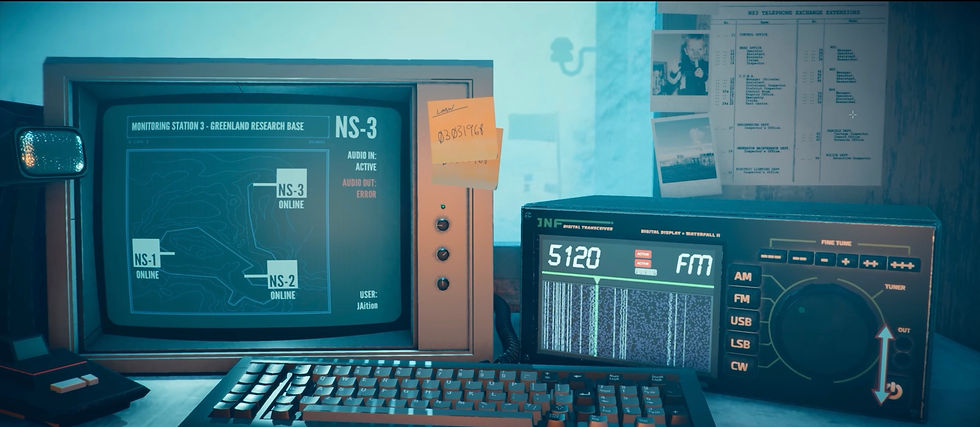
Episode 3, “The Station Process,” is set at an isolated Arctic weather station. Here, too, the standoff with precision instruments and radio equipment is obligatory. When the radio voices of staff outside come through, the player must give themselves over to the work of tuning the frequency by fine degrees.
Discerning vocal clues by ear amid the white noise, decoding code words and Morse, all while entering the derived commands into the prompt without a typo — these are passages demanding a considerable delicacy of concentration. In this episode one struggles, in particular, with reading manuals on a microfiche reader whose film must be advanced by hand and refocused each time. There is even the twist of having to recall a voice signal that has already passed — of all the episodes, this is the one laced most often with elements that provoke cognitive overload. Through it all, the various interfaces endlessly delay and disturb the player’s stable control, and the audiovisual performance required to approach memory is asked to swell larger still.
The belief that the player controls the interface: the latter part of Episode 3 intimates a powerful doubt of it. The player is flung out of the station by something, and what spreads before the eyes is only a snowfield, directionless. At the same moment, the mouse cursor’s presence abruptly vanishes. Here the work briefly puts away the arrangement of the earlier episodes — diegetic machinery set squarely before the eyes — and evaporates the “mouse cursor” as well. Even the link to the device that had most intuitively mediated the player’s body and the virtual world on screen is severed. What is interesting is that though every interface before one’s eyes has gone, the player enjoys no liberation from it. The cursor’s sudden absence makes one realize, all at once, the paradox: how much one has depended on the interface to perceive the virtual world, even while pressed upon by it.
The cultural critic Mark Fisher once wrote of the eerie: it arises, he says, when something is present where there should be nothing, or when nothing is present where there should be something[11]. The chill sensed in this scene works, I think, on a similar principle. The mouse cursor that ought to exist has vanished, and yet the player’s body still moves as if groping for it — and there is an eeriness in becoming conscious of its absence all the more vividly for that.
The player then barely makes it back to the station. But what appears there is not the station grown familiar to the eye — it is the old room of Episode 1, showing itself again. This is staging with a twist in mind; more strictly, I judge it a spatial return intimating that the fragmented performances accumulated by way of the interfaces, and the memories obtained through them, have at last begun to converge into a single memory. The player has returned to the same space. But the memory now converging no longer allows that space to be read as before. And a sense of crisis descends: that one has not been operating the interface — that in fact one’s sensation and perception have been gradually operated upon by it. This relation of the interface inverted, cutting across an eerie boundary, is also the most dramatic phenomenon of the “interfacing of memory.”
4. Breaking the “Story Untold”: The Materiality of the Old Interface
Stories Untold is a game over which a peculiar laboriousness hangs. Memory, first of all, is not kindly delivered here. To witness it, the player must contend without pause with the doors that stand shut along the way to memory. Those doors are the interfaces, and co-existence with them is required of the player as well. Attempts at an uneasy contest of strength become necessary: hammering the keyboard until the hands run hot, turning dials, tuning frequencies while groping through rough manuals to decode them. This series of performances is no one-off procedure for peeking at memory. It can be named, rather, the precondition the player must bear again and again — the ground of the game — for the sake, ultimately, of breaking open the protagonist’s “story untold.”
Memory, for the player, is not something discovered linearly. But interaction with the multilayered interfaces accumulates the results of performance, and memory then begins to swell into a form from which inference becomes possible. Memory typed, scrolled, decoded. At first these fragments lie scattered, unconnected; in the end they cohere toward one current of memory — the truth. This process of composing memory after the fact through the material filter of the interface, and the work of sinking into it, arrives as the peculiar unease — and the aesthetic — of Stories Untold. The question that remains, last of all, is why this game has built the appearance of memory upon the materiality of an interface so old and so coarse.
The question connects directly to why Stories Untold so tenaciously summons the classic hardware of the 1980s. The interface of Episode 1, representatively, draws hard on the ZX Spectrum — the British home computer released in 1982 — and the CRT monitors, instruments, radio, and microfiche reader that follow are likewise minute realizations of the sensory feel of the analog devices of that day.
Here we may consult the media theorist Jussi Parikka, who has remarked that media culture is not a place where relics of the past are simply stuffed and mounted, but a dynamic process of time and materiality in which the past may suddenly be discovered anew and new technologies grow obsolete ever faster[12]. Old media, in other words, are not confined to representations that display the past. On his account, an old interface, too — if it carried the technical sensibility and mode of operation of its day — holds the possibility of functioning as a material condition that lets those things be experienced again within the present.
Room then opens to read this work, likewise, as not stopping at placing its old interfaces as objects of retro staging, or of nostalgia to be savored. Rather, when they are summoned before the eyes, the player faces the position of having to relearn, with their own body, modes of operation grown strange today, or already faded. And in that process the past — the past’s interface — is experienced not as a flat, fusty image but as something regaining the power to operate within the damp sensation of the present. Ultimately the game actively harnesses just this old material sensibility — and through it, one gathers, it has a way of forcing that dynamism by which even the past memory the protagonist refused to the end to summon into the present, and wished would fade, is called back into the present through the player’s performance.
Episode 4 (“The Last Session”) is, ultimately, the passage in which the whole inner history of everything so far is drawn together. Not everything can be explained here, but to put it simply: for the protagonist, the interface was a psychological shield for evading and suturing his own terrible fault — the story untold — while the player, paradoxically, became the potent performer who passes doggedly through that shield and composes the memory (the truth) anew. In that sense this is not a game for the easeful enjoyment of past media; it carries a history that makes one consider the significance of the “(old) interfacing of memory” — the dimension in which past memory comes to operate again within the present body, by way of the materiality of old interfaces. Memory in this work cannot be seen as an object preserved fixed in the past. It is an experience that can be composed anew, in the present, within the performance that passes through the interface — and Stories Untold is a game implicated in this principle in no light way.
Everyone has a “story untold” of their own. But Stories Untold seems to ask back not after such a story’s perfect storage, but after the mediations by which it can be summoned — or what its reconstructed form is within present life. And when the memory one kept turning from is called into the present to be reconstructed again, the work makes us look squarely at the resistance that cannot face it and the courage that can — and at the eerie relation of co-existence with the interface that lies between the two. Ultimately, even at our fate of being unable to part beautifully, once and for all, with that process of memory’s reconstruction. In order to break — or not to break — the “story untold”: there are mottled memories that get drawn up from the depths of the unconscious to the fingertips.
[1] Park Geun-seo, Gamehagi [On Playing Games], Communication Books, 2009, p. 166.
[2] In game-design research, “diegetic” denotes UI that exists as an object within the virtual world, which character and player alike can perceive and operate through simultaneous interaction — as against “non-diegetic” design, which overlays 2D graphics with information delivery as its chief aim. (See Kim Ye-eun and Kim Seung-hyun, “An Analysis of User Interfaces in Virtual Reality Content and a Diegetic Design Guide,” Journal of Digital Contents Society 24, no. 11, 2023, pp. 2640–2643.) The DOS prompt and terminal screens of this game, for example, are outwardly 2D planes, but conform to the diegetic category in being represented as subordinate to an object: “a CRT monitor set on a desk in 3D virtual space.” The game folds nearly all system information, text, and tutorials entirely into physical, diegetic interfaces inside the game world.
[3] Unlike the PC version, the console ports (Nintendo Switch, PS4, etc.), where direct text entry is difficult, adopt a menu-based approach: in place of typed commands, players select and combine words (verb + noun pairs) presented on screen. (See Staff, “The tale of porting No Code’s text-based Stories Untold to Switch,” Game Developer, Mar. 11, 2020, https://www.gamedeveloper.com/design/the-tale-of-porting-no-code-s-text-based-i-stories-untold-i-to-switch.) This essay centers on the play experience of the PC version, but on PC and console alike only the mechanical mode of input differs: the essence of the gameplay — the “double interface control” by which the player must manually tune an unhospitable system of operation inside a virtual screen — and its performative value are maintained.
[4] The hyphenated “co-existence” is written so deliberately, to stress a state in which two heterogeneous beings stand opposed in taut tension — not one in which subject and object are smoothly fused. Neither the interface inside the game nor the one outside remains a transparent tool wholly mastered by the player; to progress, the player is conscripted into the passive process of holding out together (co-) with an opaque mechanical entity.
[5] Jay David Bolter and Richard Grusin, Remediation: Understanding New Media, trans. Lee Jae-hyun, Communication Books, 2006, p. 37.
[6] Park Geun-seo, op. cit., pp. 161–162: “The question of the interface carries great weight not merely as a matter of raising a game’s usability but as a principal means of experience, since mastery of the interface, and its degree, can be decisive in determining the intensity of the game experience. The most ideal form of the interface, then, would probably be ‘none at all’ — it should become, so to speak, ‘ubiquitous.’ (…) A complex, difficult interface obstructs immersion.”
[7] See Park Tae-jin, “Memory, Truth, and the Brain: A Cognitive-Psychological Study,” Dogileomunhak [German Language and Literature] 45, 2009, pp. 299–313.
[8] Bolter and Grusin, op. cit., p. 38.
[9] Jesse Schell, The Art of Game Design, trans. Jeon Yu-taek and Lee Hyung-min, Acorn, 2010, p. 312.
[10] The game’s internal help ([HELP]) system appends the following guidance: “If you get stuck, make sure you are reading the description and item names correctly, and don’t stress- finding the correct words is part of the fun!” The consolation the system offers proves, in the end, that the very process of trial and error — of cognitive delay — that the player must undergo through the interface is the core performance this game has designed: its intended device.
[11] Mark Fisher, The Weird and the Eerie, trans. Ahn Hyun-ju, Goopick, 2024, p. 99.
[12] Jussi Parikka, What Is Media Archaeology?, trans. Kwon Su-jin et al., Hyunsil Books, 2026, p. 27.
Tags:
스토리즈언톨드, 인터페이스, 기억, 재매개, 텍스트어드벤처, 미디어고고학, 마크피셔, storiesuntold, nocode, gamestudies, hypermediacy, mark fisher
글이 맘에 드셨다면 공유해보세요.