I Took a Big Walk with You: Big Walk
32
GG Vol.
26. 10. 10.
In Gameworld Interfaces, Kristine Jørgensen writes that the interface of the video game is every function that mediates between the player and the game system. In Jørgensen’s account the interface has a range beyond what we ordinarily call the UI: it includes all the surfaces of contact, the information, the operative elements by which a player faces a game. She extends the meaning further — the gameworld itself is an informational and interactive environment — and this becomes one reason video games and interfaces are so near of kin. The video game’s “gameworld” is an accumulation of information thrown at the player. Within it stand things to operate, things to interpret, things to sort and gather, things to compare. Alexander Galloway’s observation that the interface is always a process, or a translation, connects to the same context: inside the game world, the representational, the informational, and the operative lie mixed.
But how, then, is the player to know the gameworld’s way of working and the information essential to it? Jørgensen applies Donald Norman’s concept of the “signifier” to the video game interface. Norman calls the signifier a meaningful mark that provides guidance for action. Jørgensen places within the signifier’s range those elements of the gameworld’s representation that give the player guidance for interaction. Applied broadly, the concept takes in the great exclamation mark floating over an NPC with a quest, the firm visibility of a platform that can be climbed, a line like “Press X to pay respects.” The signifier carries the possibilities of interaction a game system permits — and their information — into the territory the player can perceive.
Even so, the video game interface still demands a second-order reading. What, for instance, are the two orbs of differently colored liquid set at the left and right in Diablo? A gamer versed in the grammar of games will easily understand that one is health and the other mana. But that is entirely a result of experience. To someone meeting such a game for the first time, or unaccustomed to the grammar of games as such, the two glass orbs might look like strange ornaments. Of course, playing on, they will watch the red liquid drain with each hit taken, and come to understand the meaning. The interface, that is, cannot deliver its meaning whole, ahead of the information called experience. Likewise, the item in the classic Mega Man series — “Mega Man’s head” — does not translate immediately into one extra life. For that matter, the “white orb” that restores health and the “flat blue capsule” that restores weapon energy give no purchase on their context at all until their effects are seen.

Fig. 1. The arcade instruction card for Pac-Man
Not that every video game interface is a riddle or a maze. Classically, external elements were mobilized to solve this problem — the “instruction card” attached to the arcade cabinet being representative. On this stuck-on manual were written the basic controls the game itself never taught, how play proceeds, what the items mean. In the past, a manual carrying the game’s basic information was also enclosed in the package. Through such external information, players could understand a game’s operative elements before ever touching it. The important point is that these materials included information for explaining the “interface” described above.
As information and complexity grew, and storage space became ample, such explanations came more and more to be inserted inside the game itself — most visibly in the tutorial sections so many games carry. The tutorial typically announces how each part of the player’s controls interacts and what the information marked on screen actually means, mobilizing demonstrations, pop-up windows, highlights, and text.
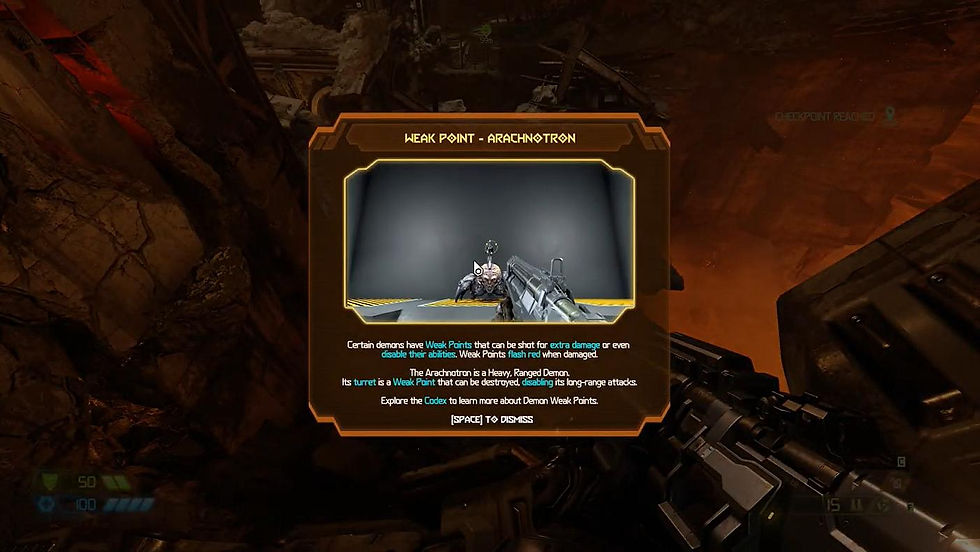
Fig. 2. The tutorial screen of Doom Eternal
The tendency is not confined to video game interfaces; the same happens readily with a car’s dashboard or a home appliance loaded with functions. The reason it stands out in video games is one: the functions a video game interface carries are extremely hard to generalize. Genre and cultural convention do, to be sure, conventionalize game systems and interface forms to a degree — think of the fighting-game convention of two long bars across the top of the screen marking health, or the controller FPS where the right trigger fires. But not every game is built on the same system, and the information each interface bears varies accordingly, game by game. Even within one series, the V-Gauge of Street Fighter V and the Drive Gauge of Street Fighter VI cannot be understood as functions of the same nature.
So, put a little more radically: the interface cannot, by itself, explain everything intuitively. At the level of the sign, it merely indicates the possibility of certain actions and their information, and the player needs a measure of experience to interpret the sign. Hence, for mastery of the interface, another stratum of interface that explains the interface (the instruction card, the game manual, the tutorial’s explanatory text) is sometimes mobilized. Let us provisionally define this kind of interface as the Interface over Interface — “IOI” for short. The account of Big Walk must proceed by way of it.
When the IOI Becomes the Goal
Imagine this. You have landed on some small, remote island. There are a few odd buildings; go inside, and each room holds suspicious devices. One has a switch, one a lever, one a circular handle. Operate each and out come numbers, images, sounds in variety. But there is one problem. What on earth are you supposed to do with these devices?
By the account so far, this is plainly a problem brought on by a vacancy of the IOI. On this island, a multitude of interfaces lies scattered. The problem we face before these devices comes at a stage prior to what must be done for the goal: we do not even know what “purpose” these devices hold. Anyone who has played games for long will quickly realize the game being described is Myst.
Myst is an interesting game — and the interest does not lie only in its well-built puzzles, level design, and environmental storytelling. As said, the problem of the IOI’s absence lies coiled here. In Myst, the puzzle divides into two strata. The first is the one we know well: understanding what a puzzle indicates, and solving it. But before that, the player must imagine what this puzzle indicates in the first place, and work out the function of each interface the puzzle presents. Only on reaching this stage can ordinary puzzle performance — arriving at the puzzle’s goal and breaking through — begin. What if we defined Myst this way: a game that has folded the IOI inside the puzzle?

Fig. 3. The puzzle interfaces of Myst
That each puzzle has its own distinct interface matters considerably for understanding Myst. Unlike other games, this game’s interface carries a rather different hierarchy across the diegesis’s inside and outside. The “game controls,” which an ordinary game would hold more important, are only a sliver of this game’s whole interface — confined to the universal physical acts of clicking with the mouse pointer to pull, turn, press. The greater presence is distributed among each puzzle’s controllers and panels. Read the manual of “how to operate the game” as hard as you like: it is no help at all in understanding the real interfaces the game offers. An IOI spanning the whole game has little utility here. Each puzzle requires an independent IOI of its own for its understanding.
Not that the IOI is wholly absent, of course. Within the gameworld, fragments of information without instruction lie strewn about, contextless. The player gathers these fragments and works out their relation to the existing puzzles — and so infers what each puzzle indicates. The crux is that this information is “without instruction.” By the earlier definition, the IOI’s key function is to explain the interface over again; this accumulation of information is therefore not itself the IOI. Players generate a “virtualized IOI” out of the unformed information — and lay this virtual mapping over the puzzle interface to complete the final picture.
Anyone who has enjoyed Myst will agree that the game’s real pleasure lies exactly in this process. Myst is a fun game because it does not explain its interface. Myst and its heirs — the direct sequel Riven; the classic escape series Submachine; The Witness and The Talos Principle, which extend the Myst form into larger open worlds — share this structure of pleasure to a degree.
The IOI as Other
The tendency to secure the IOI’s function through a manual leads us to look at Keep Talking and Nobody Explodes (hereafter Keep Talking). The game holds two elements. One: a time bomb randomly fitted with several kinds of interface panels. Two: a manual that explains those interfaces’ functions and helps one understand how to defuse them. But there is a catch. The designers did not design this as a single-player game. Keep Talking is an asymmetric co-op game. Only the defuser may see the “game screen.” The expert, who cannot see the same screen, reads the manual and relays how to defuse.
Here lies the relish of the asymmetric co-op game. Keep Talking induces the IOI to be conveyed through an added interface: communication. There is the bomb (interface); there is the bomb’s defusal manual (IOI); and it is mediated through language (IOIOI). For the IOI to reach the I, one more I is interposed. In this game, then, “language” itself becomes the IOI.
Keep Talking is, to be sure, rather one-directional: one side bears the delivery of the IOI outright. But in The Past Within — where one player acts in the past and another in the future, and each must give the other information — the two can become IOI for each other. Each checks the interface granted to them alone, and demands information of the other. Depending on who is solving which puzzle, a rhythm of toss and receive arises in the IOI’s role. It would not be amiss to call these two games collateral descendants of Myst — the game in which uncertain integration of information produces the “virtual IOI.” Here, onto the position of that “virtual IOI” is loaded the undecipherability of the language the other person throws.

Fig. 4. The manual of Keep Talking and Nobody Explodes
Connect the two games, though, and there is a rather interesting operation at work. Keep Talking is, to a degree, a game of failure. It overlaps in part with what C. Thi Nguyen calls “stupid games.” The goal is of course the bomb’s defusal, and from succeeding the pleasure flows. But at the same time, another, “stupid” kind of fun arises at the pass where the two keep missing each other’s meaning — and finally burst into (ridiculous) indignation: “how could you possibly explain it that way?”
In The Past Within, by contrast, stronger than the verbal slapstick of broken communication is the pleasure that comes when two people’s imprecise communication gives birth to precision. Perhaps these multiplayer games that touch the IOI of language and communication hold a lesson of this kind: when hierarchy is leveled before the problem of asymmetric information, we receive a palpable sense of being bound to one another.
I Took a Big Walk with You
Even granting that The Past Within presupposed the mutual act of handing each other information, it still assigned fixed positions — who will be in the past, who in the future. The game makes of the difference “you and I” a possibility of cooperation; and yet within a single session of The Past Within, you and I remain forever distinct beings. Big Walk unties exactly that fixity of roles. Big Walk pushes the player back into the world of Myst. The thing is — it pushes them in with others mixed in.
A player starting Big Walk will likely be as bewildered as one starting Myst. The game begins without context in what looks like a gymnastics training hall, then conveys how to play through nothing but diagrams of the controls and a few interactive fixtures. One feels no desire on the game’s part to inform the player of anything. The player must, one way or another, voluntarily learn the game’s elements one by one in this unaccommodating world. Leave the tutorial space, and before you spreads a natural environment (unexpectedly worth looking at) and starkly alien monochrome artificial buildings. And the question that rises is the same as ever: “so what am I supposed to do here?”
Big Walk is an open-world game. The game never states it, but players come, by experience, to understand what it indicates. Forty-five puzzles in all lie ranged across this island; solve one, and a red, tumbler-doll-shaped reward drops. Place a set quantity of these rewards at designated spots and new functions of the island unlock. The ordinary ending — call it the “normal ending” — becomes attainable at thirty rewards. It does not, of course, resolve on the spot: the designated structure must be filled with the required number, and finally one must enter the unknown structure at the island’s northern tip and pass a last trial. The text you are reading now is, next to the game itself, enormously kind. The game expects all of this — process and conclusion alike — to be recognized through experience. (I must belatedly apologize, then, that even this much information can be a considerable spoiler.)
More important still is the composition of those forty-five puzzles. Here too Big Walk proves an heir of Myst: every puzzle demands a different goal and a different action, and the game contains no explanation whatsoever for any of it.
There is a single shared point. No puzzle can be solved alone. The players must divide into at least two groups, performing different roles, to understand and solve each puzzle. In most cases, one side receives the answer, and induces the other to carry that answer out correctly. The first puzzle one meets, for instance, is this: on one side, a room pierced by a small hole. Outside, some twelve panels, and five slots to seat them in. Enter the room, press a button, and the door shuts, sealing inside from outside. Communication is possible only through the open hole. Finally, inside the room, five panels bearing images are presented in a row. That is all.
A quick-witted player will realize the panels need only be arranged in the outer slots in the order presented within. The problem: the outside player cannot see the answer sequence. The bigger problem: the answer resets every time the door opens and shuts. The players must now think up a way to convey the content. Speaking through the hole is the simplest solution — but conveying in words the “pictures” drawn on the panels can be tricky. Another way is to pull out all the panels, push them into the room, and have the person inside toss them back through the hole in order. And this counts among the simpler puzzles in the game.
Here is the difference from The Past Within: there is no system that forces or fixes a given role on a player. Every player’s capacities are identical, and which role one takes in each puzzle splits by the choice of the moment. Try a puzzle once and, if you like, swap roles and try again. Big Walk, in other words, says: whatever your headcount, however you divide the team, whatever method you use to clear — no matter. Just supply the answer the puzzle requires. Only, you will suffer the pains of communication along the way.
In many cases, the two groups divided by a puzzle’s space are placed in a state of communicative incapacity. The game treats the voice, at base, as the product of a “realistic” medium: as distance grows, or space is sealed, sound ceases to carry. The radio, which does support long-range talk, goes dead in most puzzles. The moment one side enters a space, they receive information entirely different from the person in the other. All information is randomly determined at the moment of receipt, so memorization is impossible. The transfer of information is forced through conversation confined to designated spots, through signals made with the character’s poses, through surrogate communication devices installed in the puzzle itself. In extreme cases, the “two spaces of one puzzle” stand kilometers apart.

Fig. 5. The puzzles of Big Walk stress the need for an other.
The proposition of Myst lifts its head again. Myst split the puzzle into two strata: solving the puzzle itself, and understanding the puzzle’s purpose. Big Walk stacks on a further stratum: the problem of how the puzzle’s information is to be conveyed. In our language, Big Walk throws the problems of I, IOI, and IOIOI all at once, in a single lump called the puzzle. The three do not arrive procedurally; mostly they drop before the players simultaneously. And the greater problem: unlike Myst, it does not even scatter the information of a virtualized IOI about. The players alone must form the “virtual IOI” out of their own senses.
Where, then, is this virtualized IOI to be made? Approach it this way. Where The Past Within assigned different information to its players, Big Walk induces each player to see different interpretations — different realities. Standing before one puzzle, every player infers a different solution, and no one can be sure which is right. The players try; failing, they revise; and even judging rightly, they must verify to one another that the roles are being rightly performed. The mechanics of the puzzle spaces — dividing the players, making communication impossible — pry the gap between these “different realities” wider still. Keep Talking induces you to blame the other’s powers of interpretation and explanation. The Past Within induces you to affirm that the other is fundamentally different. Big Walk goes one step further: it makes doubting the other useless.
In Big Walk there is no counterpart holding an exact manual, no counterpart holding plainly different information. There is no virtualized information glinting at a slant through the fragments. That is right: there is no information. The “Interface over Interface” that would decode the interface does not itself exist. Only, the puzzles’ composition, form, function, mechanics, and possibility call out to the player’s intuition. But intuition alone will not do. Even with the exact intuition in hand, direct communication with the other player — to whom the answer must be conveyed — is cut. Now another intuition goes to work: the intuition that must decode the faint signals the other player gives. The two intuitions, nose to tail, push on toward the puzzle’s end. Is it this intuition, then, that can fill the absent IOI?
The problem is that not everyone holds intuition in the same degree. Big Walk compels “your joint participation” — while leaving open, of course, how you divide to participate. So the players, even having generated an intuition, fall into worry. The intuition for the puzzle’s workings and goal, the intuition for finding a way to signal the other, the intuition for interpreting the signal that comes from the other — are they not each different? As said above, Big Walk makes each player see a different reality. The solution my intuition has found cannot be executed without a companion who concurs. The hint my intuition has made cannot be used without an executor on the far side. Intuition does not solve the problem. Even having seen through a puzzle’s whole structure and solution, if there is no way to convey it to a counterpart beyond even the radio’s reach, it ascends to the rank of the useless.
The answer, in truth, was slipped in earlier. To stress it again: Big Walk is a game that makes doubting the other useless. The only way to solve a puzzle I have not understood is to trust the other’s intuition. And likewise: without the faith that the other will understand this strange signal of mine, the puzzles of Big Walk do not operate. In that sense Big Walk is a strange game — for the puzzle’s structure, its solution, and the communication needed to solve it are all induced to be drawn from the other’s understanding and the other’s signals. From the very start — “who will enter which room” — one must already presuppose the expectation that the other will signal rightly.
The last answer, then, is this. What does Big Walk take for its IOI? It comes down to trust in the other with whom one plays. In this barren land without one piece of explicit information by which the structure might be grasped, all that solving a puzzle requires is to believe in the other’s intuition, language, and communicability — and to fling oneself forward on that belief. This is not to say Big Walk is a game in praise of trust. The stronger phrasing may be the truer one: Big Walk is a game that converts trust into an interface. To draw on Galloway once more — the interface is always a process, and a translation. The pair of words fits astonishingly well. For trust, too, is always a process, and a translation.
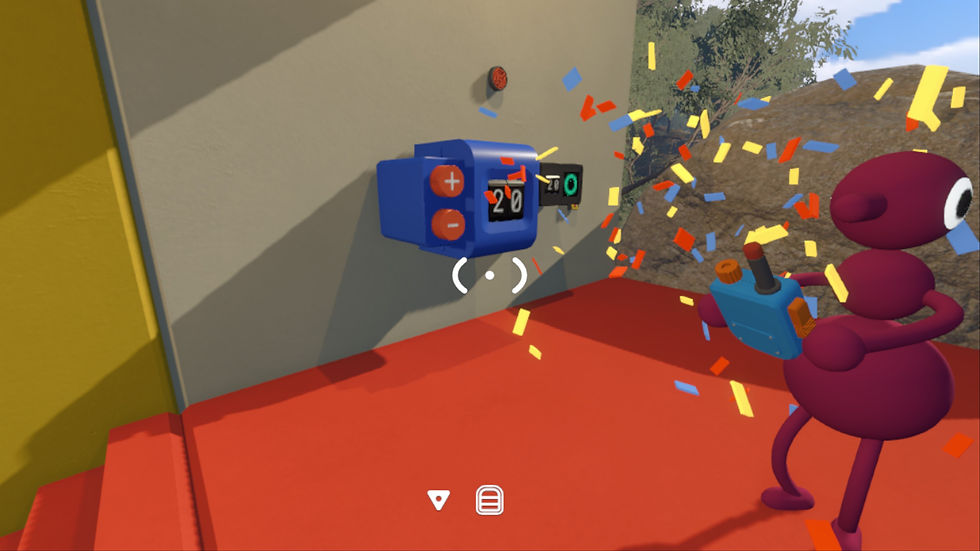
Fig. 6. Oi, oi — I believed in you!
In Big Walk, then, the other is at once a co-op partner and a game object — for they are my “interface.” They stand present as a crucial piece, occupying one vacancy in the complex construction called the game. The endings of Big Walk show a rather moving parting with the game, without passing through linguistic mediation. (The phrase “with the game” is, of course, used here in both senses.) Parting with Big Walk is still a parting with game objects. But soaked into it is the interface called an other one could trust. Comically enough, though this is someone you can speak with again the moment the ending passes, the ending’s scenery carries the feeling of someone going far away. Perhaps because, even if one can meet that other again, one has taken leave of the gameworld of Big Walk — and of the interface called trust.

Fig. 7. I’ll miss you, comrades.
Tags:
빅 워크, 게임 인터페이스, 협동 게임, 퍼즐 게임, 미스트, 킵 토킹 앤 노바디 익스플로드, 더 패스트 위딘, Big Walk, House House, Co-op Games, Myst, Keep Talking and Nobody Explodes
글이 맘에 드셨다면 공유해보세요.