
Why Farming Games Became “Healing”: Between Pixel Farming and Real Fields
30
GG Vol.
26. 6. 10.
*You can see the original Korean version of this article at: https://www.gamegeneration.or.kr/article/48a73207-79db-4c1a-9ab9-a2608d59b435

In farming simulation games such as Stardew Valley and Story of Seasons, players are given the chance to become farmers living in idyllic rural settings. These games share a similar narrative premise: leaving the city behind, inheriting a family farm, and beginning a new life. What the player first encounters is usually a long-abandoned plot of land overrun with weeds, rocks, and dead trees. The core experience of these games lies in gradually clearing the neglected farm, cultivating the soil, planting crops, tending livestock, and ultimately enjoying the rewards of steady daily labor. Along the way, interactions with the townspeople offer moments of warmth and community.
Farming games are often categorized as “healing games.” Unlike competitive or combat-oriented games that demand tension and urgency, managing a farm offers a peaceful and modest rhythm of life—quite literally, a pastoral existence. Neither the corn growing in the fields nor the cows grazing in the pasture pose any threat to the player. They simply grow under the player’s care, while the player remains an observer of that growth.
Before I experienced farming firsthand, I too consumed farming games as part of the “healing” genre. However, after leaving the city to live in a remote mountain village, experiencing rural society, and cultivating crops myself, I came to realize that the gap between farming in games and farming in reality was far greater than I had imagined. Of course, some distance between games and reality is inevitable. Yet through actual farming, I began to notice which aspects of agricultural labor had been removed, simplified, or rearranged in order to become game mechanics. In doing so, I came to better understand how the sense of “healing” in farming games is constructed in the first place.
Learning Farming Through Games
What follows is a story drawn from my own experience with farming. After leaving city life behind and moving to a remote mountain village, I was given access to a small vegetable garden near my home. When I dug into the soil, I found several earthworms wriggling beneath the surface, a sign that the earth was fertile and alive. It seemed too good a plot of land to leave untouched, so I decided to try farming for myself. In games, I had already spent dozens of virtual seasons cultivating vast fields as a seasoned farmer. In reality, however, I was a complete beginner who had never properly grown a plant before.
In Stardew Valley, the farmer’s first task is to clear and prepare the land. I found myself doing much the same thing, almost as if I were following an in-game tutorial. Squatting in the field, I picked out stones by hand, removed weeds with a hoe, and loosened the soil with a shovel. Every so often, when the sharp edge of the hoe struck the earth, an earthworm living beneath the soil would suddenly spring upward. In those moments, I felt vividly that the land itself was alive.
Once the groundwork had been laid, it was time to plant something. Ordinarily, I should have started with seeds, but instead I chose what felt like a kind of “boost item”: seedlings. Since seedlings have already passed the vulnerable seed stage, they are less likely to fail and grow more quickly once planted. The owner of the seedling shop advised me that beginners should start with leafy vegetables. I treated fruit-bearing crops like cucumbers and strawberries as though they were “high-difficulty crops” that had not yet been unlocked, and returned home carrying fifteen lettuce seedlings instead. April, with spring fully settled in, was the perfect season for planting lettuce.
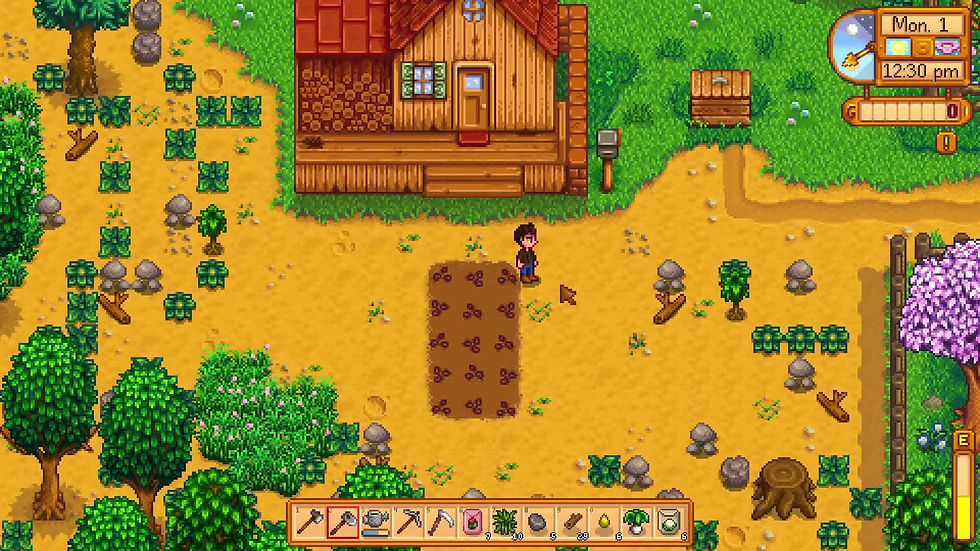
* In Stardew Valley, the player begins their first season by planting fifteen parsnips.
Planting in Pixels vs. Making Ridges and Furrows
After returning to the field, I wondered how I should arrange the fifteen seedlings. In Stardew Valley, one of the first tasks given to the player is to plant fifteen parsnip(a type of radish) seeds, a spring crop. The player equips a tool and transforms the “state” of each tile of land into arable soil, planting one seed per tile until all fifteen seeds have been sown. Most players tend to arrange their fields in symmetrical patterns such as 5×3 or 3×5 grids. They perceive this balanced pattern as a stable structure.
Having spent so much time playing Stardew Valley, I had unconsciously internalized the habit of planting crops in neat, geometric patterns. So in my real vegetable garden, I arranged the lettuce seedlings in much the same way. The lettuce, too, was planted in a tidy 3×5 formation. Yet after only a few days, the garden began to resist the logic of the game. The lettuces lacked sufficient room for their leaves to spread. As the leaves pressed against one another, airflow became restricted, creating favorable conditions for pests and disease. Packed too closely together, the lettuces entered into a quiet struggle for survival, pushing against one another as they grew.
To make matters worse, the lettuces planted in the middle row became almost impossible to manage because there was no space to reach them by hand. In the game, the player character can easily walk through crops, but in reality a farmer requires physical pathways to move through the field.
Eventually, I realized that the logic of “one crop per tile” belonged to the grammar of games. In actual farming, the concepts of raised rows for planting and furrows left open for movement and drainage are more appropriate than the abstract grid of the game world. A single head of lettuce does not merely occupy one square of space; it requires a much larger ecological area that includes airflow, drainage, and accessibility for care. The simple grid-based rules presented by the game transformed, in reality, into a far more complex problem of ecological arrangement.

* A lettuce field planted with sufficient spacing for growth. Source: Dragon Byeolbat Atelier blog
Real Farming Treats Crop Damage as the Default Condition
Even in such cramped conditions, the lettuces managed to grow surprisingly well. I carefully harvested a few leaves at a time and was able to enjoy the first yield. Wrapping rice and meat in freshly picked lettuce or making generous salads from the harvest, I found myself thinking that, in at least one respect, I had surpassed the farmers of farming games: actual cooking and eating. No matter how much lettuce I picked, it seemed to grow back endlessly, almost like an inexhaustible spring.
But the joy of harvest did not last long. Only a few days later, when I stepped outside to water the garden, the field was empty. The places where the lettuces had stood had simply vanished. The lettuce had been there, and then it was gone. For a moment, it felt so strange that I wondered whether I had somehow walked into the wrong field. The culprit turned out to be roe deer. In retrospect, it must have looked irresistible to them. Compared to the tough wild grasses growing elsewhere, my garden was a perfect buffet filled with tender, soft lettuce leaves.
In most farming games, fences function either as decorative elements or as optional structures. In Stardew Valley, crop damage occurs only as a minor event. If crops are planted outside the area protected by a scarecrow, one or two may disappear overnight after being eaten by crows. Farming Simulator does not meaningfully simulate pests or wild animals at all; weeds merely reduce crop yield slightly. Meanwhile, Sakuna: Of Rice and Ruin portrays insects, plant diseases, and weeds affecting rice cultivation in much greater detail. Yet even there, failure usually results only in lower quality or reduced harvests—the entire crop rarely dies outright.
Reality, unlike these peaceful games, proved far harsher. Because I had not installed proper deer fencing, the lettuce patch disappeared almost overnight. In real farming, uncontrollable variables—wild animals, heat waves, monsoon rains, pests—can invade at any moment. Diseases and insects are capable of destroying an entire crop within weeks. Excessive heat or humidity quickly spoils plants, while a single heavy rainfall can rot their roots. Farmers therefore approach these threats not as rare accidents but as default conditions of agriculture. Farmers must treat these risks as the “default” and maintain their crops by mobilizing every possible countermeasure—fences, pesticides, fertilizers, and drainage systems—as a matter of course.
Healing Becomes Possible Only When the Laboring Body Disappears
After my lettuce patch was devastated by wild animals, I regrouped by planting several asak-i pepper plants, a crop suited for summer. Energized by the warmth of early summer, the peppers steadily extended their stems, bloomed, and seemed ready to bear fruit in abundance. Then one day, the green stems had turned black. Looking closer, I discovered dozens of stink bugs clinging tightly to the plants and sucking out their sap. Stink bugs do not immediately destroy the fruit, but they steal nutrients from the plant, weakening its growth and leaving the peppers stunted and unhealthy.
I could have used pesticides, but many environmentally conscious farmers discouraged it. Instead, they advised me to remove the insects by hand. I filled half of a cut plastic bottle with water, held it beneath the pepper stems, and shook the clusters of bugs loose with my fingers so they would fall into the container. This had to be repeated every single day. Once the war against stink bugs subsided, slugs appeared in the humid summer weather and began gnawing at the peppers instead.
Through this process, I confronted the physical pain of farming in a way games had never prepared me for. Standing outdoors for only a few minutes in midsummer was enough to leave my entire body drenched in sweat. Mosquitoes are inseparable from the farmer’s life. Summer fields are ideal environments for swarms of wild mosquitoes, and merely brushing against plants can leave ticks attached to one’s skin, feeding unnoticed on blood. The farmer in Stardew Valley wears a romantic outfit of straw hat and overalls; the real farmer dresses instead in survival gear—wide-brimmed hats, masks, arm sleeves, and scarves.
In Stardew Valley, the player’s body is represented only through a “stamina gauge” tucked into the corner of the screen. Swinging a pickaxe or watering crops gradually depletes the gauge, and when it reaches zero, the character collapses from exhaustion. Yet after a single night’s sleep, their energy returns as though nothing had happened. Because labor in games is mediated through control devices, the player never experiences sweat running down their body, the sharp pain of an aching back, or the misery of insect bites. The “healing” offered by the game is made possible, paradoxically, by erasing the physical body of the laboring subject.
Real farming does not end with a few clicks, nor does accumulated exhaustion disappear after a night’s sleep. These bodily limitations inevitably require external assistance. It is no coincidence that Farming Simulator derives much of its appeal from operating enormous tractors and combine harvesters. Modern agriculture has long depended on machines to shoulder workloads that the human body alone cannot endure.
Looking at the reality of rural Korea, the machines that replace human bodies in aging farming communities are agricultural vehicles worth tens or even hundreds of thousands of dollars. The operation of these machines—and much of the difficult manual labor that machines cannot perform—is largely carried out by migrant workers. The polished vegetables sold in supermarkets are produced amid the noise of machinery and the sweat of migrant laborers, realities absent from healing games. Even the recently celebrated “smart farm” model moves toward eliminating unpredictable and painful forms of human labor in nature by entrusting temperature, humidity, and nutrient control to artificial intelligence and automated systems.
Ultimately, the tranquility offered by farming games emerges through the removal of the painful physicality and labor structures that real farming inevitably entails. What remains is a carefully distilled experience that preserves only the satisfaction of harvest.
The Farmer in Games Is Healed, While the Real Farmer Struggles to Survive
We need to reconsider what we mean by the feeling of “healing.” Farming becomes healing in games not simply because of their pastoral settings, but because they remove and transform the complexity of real agriculture, reconstructing uncertain labor into “certain labor.” Real farming is a complex and unpredictable activity shaped by countless variables: climate, pests, labor conditions, market fluctuations, and more. The effort required to bring crops to harvest is physically demanding, painful, prolonged, and often accompanied by failure.
Games, by contrast, are designed as a medium that minimizes discomfort and maximizes pleasure. If they were to reproduce the uncertainty and suffering of real farming in full, they would lose the core engine of “fun.” For this reason, games about agriculture inevitably simplify reality through processes of selection, omission, and exaggeration, reconstructing farming into a form that can be played.
From this perspective, one might criticize farming games for concealing reality. Yet what matters is not whether reality is concealed, but rather how farming is structurally reorganized into an experience of healing. Once we become aware of this gap, the healing produced by farming games no longer appears as mere fantasy. Instead, it becomes an analytical point from which to rethink the conditions surrounding real agricultural labor.
Paradoxically, perhaps modern people find healing in farming games precisely because their everyday lives are far more uncontrollable and unpredictable than the farming depicted in games. In contemporary labor environments—where effort often goes unrecognized and results remain uncertain no matter how hard one works—farming games offer a fair world in which labor reliably produces rewards. Plant seeds and water them, and crops will always grow. Harvest them, and money will always follow. The predictability and controllability created through this clean cycle of repetition may in fact constitute the true essence of the healing these games provide.
But why, among so many possible forms, does this healing so often take the form of “farming”? Agriculture, humanity’s earliest productive activity, originally involved negotiation with nature and coexistence with uncertainty. Games, however, remove this uncertainty and remake agriculture into a controllable system. In this sense, farming games may reflect a modern fantasy—the desire to fully quantify, manage, and domesticate nature itself.
At the same time, farming games evoke nostalgia for something we have lost: touching soil with our hands, planting seeds, and watching life grow. In urbanized modern life, most people no longer know where or how their food is produced. Farming games imaginatively restore this severed relationship.
Ultimately, the healing offered by farming games is double-edged. On the one hand, it is a safe fantasy that erases the pain of real farming. On the other hand, it provides a fundamental sense of satisfaction through the direct connection between labor and reward—something many people rarely experience in everyday life. The experience of becoming a farmer in a game poses difficult questions to us: Why do we seek in games a satisfaction we cannot attain in reality? Why is our labor not connected to clear rewards in the way farming games promise? And might genuine healing arise not from eliminating uncertainty and suffering, but from learning to live with them?
Such questions encourage us to move beyond simply consuming farming games and instead reflect on the desires for labor, nature, and healing that define our era. The gap between farming in games and farming in reality ultimately reveals both the world we currently inhabit and the world we long for.

