
But Nothing Tastes of Anything in Game Cooking
30
GG Vol.
26. 6. 10.
A great many of a game's play elements and mechanics are realized by imitating those of reality. Simulating any number of acts or phenomena—natural law, administrative procedure, the common sense of the humanities—is the basic stuff of games. One of the pleasures you feel while playing is hunting for how these copied phenomena and acts of reality come out similar and how they come out different.

One representative mechanic—very often found in games, yet one in which you can feel the dilemma of implementation—is cooking. Though it is one of life's essentials, an indispensable element of how we live, it always runs into difficulty when implemented in a game.
Cooking is, at bottom, the act of following a formula called a recipe. Even the simplest dish has a method of preparation. For that reason it has been used in countless games as a puzzle element, where you have to carry out a process without error.
The problem is that when you implement cooking as a piece of gameplay, behind success there is failure, and once you have cooked, there is a product called food. In all gameplay, the value of success arises because there is a risk of failure. But failure in cooking has something slightly puzzling about it. First of all, what is a "failed dish"? In reality, what does it mean to fail at a dish?

Thought of simply, the crux is, of course, "taste." Setting aside the matter of nutrition—possible with any digestible organic matter—the most important thing in cooking, in food, is taste. Especially when we look at cooking as a process: the very reason we follow a formula called a recipe is to make the most delicious food through proper preparation, so whether the process of "cooking by following a recipe" succeeds is, in the end, governed by taste.
But, as with any other everyday mechanic, the biggest problem in implementing cooking in a game is that this core value—the status called taste—cannot be conveyed to players the same way it is in reality. In the end, such acts or mechanics in a game can only be recreated on a basis of quantification, and cooking is no exception. Yet even so, compared with other elements whose quantification can at least be roughly gauged, can the value called taste be expressed as a parameter?
In the end, the failed dish of reality and the failed dish of a game arise from this difference in conveying sensation. It would be no lie to say that taste is nearly the whole of what decides whether a dish succeeds—and yet in a game that taste cannot be conveyed. So the work of redefining success on the basis of "tastiness" comes first. What value does a "delicious dish," a "delicious food," hold? What concrete effect can "tastiness" be defined as?
After some deliberation, a great many games took this effect of "tastiness" to be a kind of boosting effect on the player who consumes it. Delicious food fundamentally elevates the happiness of the human who eats it. Secondarily, if that food's ingredients or preparation are especially healthy, it plainly has a positive physical effect as well. And so most foods and dishes in games provide the consumer with a buff, and confer a better effect when they use rarer ingredients, go through a more complex preparation, and take a more delicious form (in the comprehensive sense). But another problem is that this stat-boosting element is not always present in every game.
In the end, to judge the product called a "delicious dish" in a game, it seems we first have to look at what a "bad dish" or "failed dish" looks like in that game.

Personally, I think the types of "failed dish" in games can be sorted into three. They are as follows. 1. No food is produced at all. 2. A separate "failed food" is produced, carrying a negative effect or a smaller positive one. 3. A failed dish equals game over, or mission failure.
The first—where failing at cooking produces no food at all—can be found, for a recent example, in Mabinogi Mobile. In this game, cooking is based on probabilistic generation: you put ingredients into a crafting station according to a success rate broken into ten-percent increments, and food is produced by chance. A very simple method.
The second—where a separate, lower-performing failed dish is produced—is also a method adopted by a great many games. To take a representative case, in the Monster Hunter series, the meat-grilling action traditionally included takes the basic form of a simple puzzle where you press a button on the beat. As the meat grills, it changes appearance across three stages, and you press the button to finish when the grilling meat looks properly done. Fail, and you produce undercooked or burnt meat, set to give a smaller positive effect (a stamina increase).
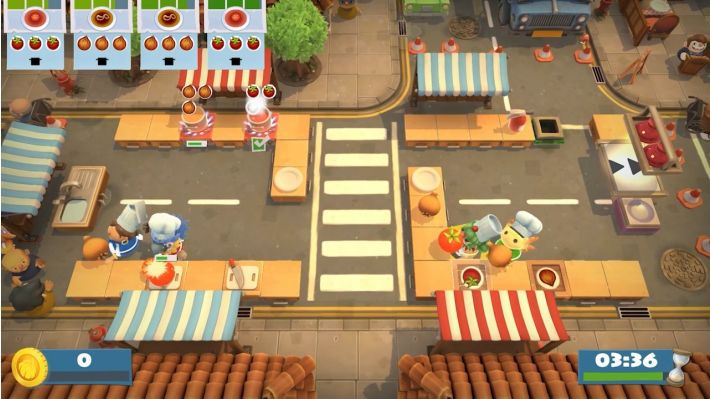
The third—games where whether cooking succeeds or fails is the very criterion deciding whether the game succeeds or fails—also turn up now and then. The representative case is Overcooked!, where cooperatively making dishes is the outright goal, and the Coffee Talk series can broadly be included here as well.

In Coffee Talk, a drink is produced no matter what ingredients you put in, but there is a set right answer for what to serve whom, and you have to match, one by one, the combination of ingredients that customers order in vague terms, complete it, and serve it. That is, here a successful dish means not the completion of the dish itself but "matching the eater's preference," and since matching it affects the game's ending and achievements, it amounts to judging the food's success by the game's level of accomplishment itself.
The interesting cases here are the second type. To have an item whose only use is a "failure verdict" occupy space in a game's item database is, in itself, no better than dead weight. Beyond that, there are cases where this "failed dish" comes to have a use, for various reasons.
Looking at games where the "failed dish" produced this way has a special or useful purpose, representative examples include the Rune Factory series and, among more mainstream games, Genshin Impact.

(Image source: Rune Factory 4 info bot @RF4_KR_info)
The failed dishes of the Rune Factory series occur when you cook in a way that departs from the recipe. These dishes can be used to inflict debuffs on enemies, and also to raise the affection of certain NPCs with peculiar tastes. In Genshin Impact, too, failed dishes have a similar use. You make a strange dish to serve, or give it as a gift to raise affection. There is even an achievement for producing this strange dish. And in Monster Hunter as well, some items call for improperly grilled meat as a material.
As a result, the standing of "cooking" and "food" in a game shifts according to two approaches: using cooking as a kind of skill check, and using the item called food as a hurdle to obtain. Overcooked! and Coffee Talk are games that put the skill check of cooking to use in their own ways. The Monster Hunter series, the Rune Factory series, Mabinogi Mobile, and the like are processes for obtaining the item called food, where failing yields an unsatisfactory product. And by this point, you start to wonder what on earth "taste" has to do with judging these dishes.
As said earlier, this gap fundamentally arises because the concept of "cooking" in a game cannot directly convey taste to the player, so a difference emerges—conceptually and expressively—from the "failed dish" of reality. In reality you can just say a dish "tastes bad" and be done with it, but since that taste cannot be conveyed inside a game, the "failure" gets substituted with various other concepts, and that is how this comes about.
A similar feeling exists in reality, too. Because there is no absolute standard for telling a delicious dish apart. It tastes bad to me but fine to someone else; or it isn't a satisfying taste, but considering the price it seems okay; and it doesn't look bad either... or conversely, it isn't bad, but at this price this level shouldn't pass. No one would dispute that "taste" is dominant in telling apart a "delicious dish" in reality, but because the weight that "taste" carries, the expectations, and the preferences themselves all differ, it is, if anything, hard to divide success from failure.
In the end, success and failure in a game's cooking needed a clear standard, unlike in reality, and the two had to be dramatically contrasted. What's more, because this cooking—and the item called food—carries a different weight in play from game to game, the concept of the "failed dish" branched off in all directions, and since the "successful dish" set opposite that "failed dish" likewise kept changing, the gap between cooking in reality and cooking in a game, far from narrowing, only widened. That is, the attempt to copy real cooking as closely as possible inside a game ends up, in the end, creating distance instead.
Of course, that does not mean the value standard of in-game cooking may become wholly unrelated to reality. In the end, the dishes and recipes that appear in a game can only be drawn from, or based on, those of reality, and if a game were full of nonsensical skill checks—like the once-popular flash game Hometown Dumplings—you would not be able to relate to the cooking it shows at all. The point is that, although the player cannot taste it directly in the game, the game must let them infer that taste through the recipe, the appearance, the preparation, and so on. Only when a game persuasively presents the logical connections that lead to that taste (the method, the appearance, the kinds of ingredients) can it narrow, even a little, the gap between in-game cooking and real cooking and let the player associate the taste indirectly.
So the cases where a dish or food appearing in a game stayed especially in memory were, rather than how its taste was expressed, when it properly conveyed the meaning a dish carries by using the food's characteristics other than taste. If you can't win on taste to begin with, you can win on feeling.

So there are cases where cooking done not for some definite value or grand purpose, but simply as an ordinary act, lingers more deeply in memory and carries more meaning. In Sakuna: Of Rice and Ruin, farming and cooking rice is not particularly exceptional gameplay, nor is it making some grand dish—yet the memory of harvesting hard-won rice, cooking it, and sharing it with companions stayed with me as something so special. In the Coffee Talk series mentioned earlier, mixing a given drink doesn't bring back some great effect either, but to hear a character say just one line—"I like it"—after drinking, I would review the recipe and retry again and again.
This is because, ordinary an element as it is, the satisfaction cooking brings is at once universal and special, and because cooking, within a given process, greatly affects the player's actions and sense of immersion. In the Monster Hunter series, for instance, cooking and food are strictly part of the process of preparing for a hunt rather than the main content, and also a function for checking the player's state of readiness.
To that extent, among the games introduced above, the cases where cooking—small or large—was well received when implemented in a game were shaped as much by the justification for the act of "cooking" being there as by the logic of the mechanic or the aptness of its implementation. Cooking is an element that maintains the everydayness within a game and draws in the player's immersion, and at times it is also an object symbolizing a bond with other characters in the game.
In this respect, the use of cooking and food, in a game or in reality, does not differ much in the end. It is simply whether or not you can taste it—and in this respect it seems to share a context with cooking and food as indirect experience, seen through the cathode-ray tube rather than eaten by us directly. Expressing the characteristics of some substance with the core sense excluded seems, at first glance, impossible; but just as we can sometimes know beauty even without seeing it, the value of a fine dish, a delicious food, is bound to come through one way or another.
Tags:
글이 맘에 드셨다면 공유해보세요.

