
The Ghost Games: A Parry Through Chanbara's Tangled Family Tree
30
GG Vol.
26. 6. 10.
Chanbara (ちゃんばら) is a compound of chanchan (ちゃんちゃん), the onomatopoeia for the sound of clashing blades, and barabara (ばらばら), the onomatopoeia for the sound of blood scattering. Originally a term of derision for the slapdash Edo-period costume dramas churned out in bulk, it is now used as a genre label covering films, novels, games, and plays in which samurai, ninja, and the like carry on their action with bladed weapons. There is even a sport called chanbara that uses foam swords and padded weapons, so the term itself can be said to circulate widely, indifferent to genre or medium.
Chanbara first came into popular use in the dawn of the Japanese film industry, from the 1920s up to the defeat of 1945. Chanbara theater did exist in the late nineteenth century, but it was the costume dramas mass-produced from the silent era onward—taking swordplay as their central material—that fixed the word in popular usage. In the period when imperial Japan was beginning its wars in earnest, the chanbara costume drama was also pressed into service as nationalist propaganda emphasizing bushido. By one count, six thousand costume dramas were produced in Japan from 1908 up to the defeat, a figure equal to half the films made in the country.[1] Not all of these, of course, would have been chanbara films.


Poster for the arcade game Chanbara (top) and the cover of Onechanbara*, released on PS2 (bottom).*
For this reason chanbara can be seen as a subgenre of popular culture boasting a history of more than a hundred years. Games that actively took up chanbara can be found from the 1980s, the moment when richly varied graphics began to appear in earnest. From Sega's arcade game Samurai (侍, 1979) and Data East's side-scrolling action game titled, right on the nose, Chanbara (ちゃんばら); through fighting games like Samurai Shodown (サムライスピリッツ, 1993) and Bushido Blade (ブシドーブレード, 1997); to the ninja-infiltration action of Tenchu (天誅, 1998) and the recent Sekiro: Shadows Die Twice (セキロ, 2019)—it would do no harm to file most action games with samurai and ninja as protagonists under the heading of chanbara games. After all, there is even a game like Onechanbara (お姉チャンバラ, 2004), billed as bishōjo-zombie action.
To set the starting point of this genealogical sketch outside of games is only natural, since chanbara seeped into popular culture through the films (and a few novels) of the early twentieth century. In the lineage of exploitation—where a word first used as an insult settled into a genre as the works piled up—chanbara holds its place with confidence. Ghost of Tsushima (2020), the final exclusive for the PlayStation 4, and its successor Ghost of Yōtei (2025) can be called the most recent works of the chanbara genre as it has settled into popular culture. Nate Fox, the creative director of both games, has stated that he was influenced by the chanbara manga he read in childhood, such as Lone Wolf and Cub (子連れ狼, 1970–1976) and Usagi Yojimbo (兎用心棒, 1984–). I leave them unmentioned because it is not an area I know well, but anime like Samurai Champloo (サムライチャンプルー, 2004–2005) and manga like Bleach (ブリーチ, 2001–2016) and the recent mega-hit Demon Slayer: Kimetsu no Yaiba (鬼滅の刃, 2016–2020) can be said to profess the chanbara genre or to fall within its sphere of influence. When the American studio Sucker Punch announced it would make a chanbara game, that these would become its primary references was a matter of course.
To bind into a single genealogy the chanbara scattered across the whole field of popular culture would be impossible. What can be drawn, though, is an unfinished genealogy that moves between film and game—the traits of chanbara one comes to feel while playing Ghost of Tsushima and Ghost of Yōtei, or the path running between the spaghetti Westerns and other Westerns born under chanbara's influence and the Japanese-style Westerns that branched off once that influence returned home to Japan.
From Western to Chanbara, and Back to Western
In a Japan where, after the defeat, the Occupation forces had banned the depiction of swordsmanship and other martial arts on film, the revival of the chanbara film came through Akira Kurosawa. Not long after the Occupation's censorship was lifted in 1952, Seven Samurai (七人の侍, 1954) was released. Because this was the Kurosawa who a few years earlier had taken the Grand Prix at the Venice International Film Festival with Rashomon (羅生門, 1950), another masterpiece from his hand at once captured the critics and the public alike. Kurosawa makes no secret that his chanbara films—the series of films starring Toshiro Mifune as a samurai—were influenced by the Hollywood Western. In the early twentieth century, when the chanbara film was gripping the Japanese public, the genre that flourished alongside it was unquestionably the Western. From the silent era through the postwar Occupation, the Western was the biggest film commodity not only in Japan but worldwide. Kurosawa, too, took the Westerns of this period as his chief motif.


Seven Samurai (top) and How Green Was My Valley (bottom).
The setup, for instance, of a near-rōnin samurai helping villagers face off against bandits immediately calls to mind a film like John Ford's My Darling Clementine (1946). Though not a Western, John Ford's How Green Was My Valley (1941) is also drawn upon for scenes in Seven Samurai. The scenes in Yojimbo (用心棒, 1961) and Sanjuro (椿三十郎, 1962), where the wandering rōnin departs right after the final duel, naturally summon up not only Ford's Stagecoach (1939) but George Stevens's Shane (1953) and Fred Zinnemann's High Noon (1952). Even in a war film like Throne of Blood (蜘蛛巣城, 1957) or an adventure like The Hidden Fortress (隠し砦の三悪人, 1958), Kurosawa put a katana in Mifune's hand and had him swing it. As John Wayne's figure functioned in Ford's films, Kurosawa made Mifune's feral aspect the emblem of the anti-hero in his own.
As if in answer to the signal flare of chanbara's revival fired off by Kurosawa, several chanbara series appeared in succession. Zatoichi (座頭市, 1962), starring Shintaro Katsu, takes a blind swordsman as its protagonist and runs on through twenty-six sequels and a remake directed by and starring Takeshi Kitano. Lone Wolf and Cub: Sword of Vengeance (子連れ狼 子を貸し腕貸しつかまつる, 1972), produced by the very Shintaro Katsu who played Zatoichi, was based on the manga of the same name and, recording a major hit, was made into six films and a TV drama. Alongside their popularity in Japan, these works were categorized—together with Hong Kong kung-fu/wuxia films and Korean kwŏn'gyŏk (fist-fighting) films—as "Asian martial arts films," and circulated worldwide in the form of pirated prints, unauthorized dubs, and recut versions.
Of course, the films of the Venice Grand Prix laureate Akira Kurosawa were introduced around the world through official distribution networks and exerted great influence on Europe and Hollywood. Steven Spielberg and George Lucas put out Star Wars (1977), effectively a remake of The Hidden Fortress. In being a pseudo-Western set in space, this creates a strange genealogy in which the films of Kurosawa—who took John Ford as his cinematic master—pass through chanbara and circle back once more to the Western. A more direct uptake took place in Italy. A Fistful of Dollars (1964), produced by Sergio Leone with Clint Eastwood, lifts Yojimbo wholesale—so much so that there is an anecdote about Eastwood thinking of Yojimbo the moment he read the script. That said, Leone's spaghetti Western drags over only the shell of the chanbara film Kurosawa made. He takes only the components—the plot, the anti-hero character, the showdown—and makes a film of an entirely different character. Different, one might say, from Kurosawa's films, which transposed the way the John Ford Western depicts America into something Japanese.


The similar compositions of Yojimbo (top) and A Fistful of Dollars (bottom).
In any case, through Leone's films the Western entered a different phase. The outlaw anti-hero became the mainstream of the spaghetti Western, and the level of violence rose above that of the 1930s–50s Western—as in the machine-gun spraying of Sergio Corbucci's Django (1966). Hollywood, too, put out The Magnificent Seven (1960), a direct remake of Seven Samurai; this drew notice for its glittering star casting, but the film's own impact was not large—though it did become a film that, together with spaghetti Westerns and revisionist Westerns like The Wild Bunch (1969), spawned countless imitators.
The spaghetti Western, influenced by Kurosawa's chanbara films, returns to Japan once more—just as in 1970s Korea the Manchurian Western emerged under the influence of Leone's (and Kurosawa's) films. Juzo Itami's Tampopo (タンポポ, 1985), which hauls in a great heap of Western clichés, used "ramen Western" as its promotional tagline, displaying Japanese cinema's answer to the spaghetti Western. An anime conscious of the Western right down to its title, like Cowboy Bebop (カウボーイビバップ, 1998), recorded a major hit, and Takashi Miike, a master of Japanese genre film, even made it into the competition section of the Venice International Film Festival with Sukiyaki Western Django (スキヤキ・ウエスタン ジャンゴ, 2007). The manga Golden Kamuy (ゴールデンカムイ, 2014–2022), which reached its conclusion a few years ago, carried on the tradition of the Japanese Western too, setting itself in Hokkaido and featuring Ainu people as major characters.
Chanbara as Cultural Melting Pot, or Chimera
So… the work of drawing a genealogy that moves between Western and chanbara brings on a certain awkwardness. As one can see from the countless films mentioned above, drawing the genealogy of these films is possible, but it is no different from a maze in which one is bound at some point to lose the way. Genres mix across borders—as in Zatoichi Meets the One-Armed Swordsman (新座頭市 破れ!唐人剣, 1971), the twenty-second film in the series, which attempted a kind of collaboration with the Hong Kong wuxia masterpiece The One-Armed Swordsman (獨臂刀, 1967)[2]—and, as seen above, diverse mutations are born within the repetition of a genre's import and re-import. Indeed, unlike Japan's pre-defeat chanbara films, which put bushido forward as their theme, the chanbara films after Kurosawa (as the revisionist Westerns did) exposed the cruel violence and toxic masculinity inherent in bushido, and at times revealed an aversion to the lingering traces of feudalism. Masaki Kobayashi's Harakiri (切腹, 1962), which took ritual disembowelment as its material, and Bushido, Samurai Saga (武士道殘酷物語, 1963), which criticized the totalitarianism grounded in bushido, appeared around the same time as Kurosawa's chanbara films. Chanbara films critical of bushido continue to appear to this day: The Twilight Samurai (たそがれ清兵衛, 2002), portraying a fading samurai at the end of the Edo shogunate; Nagisa Oshima's Taboo (御法度, 1999), treating the male homosociality grounded in bushido; and, similarly, Takeshi Kitano's Kubi (首, 2023), treating the (sexual) violence within a samurai band of the Sengoku era.

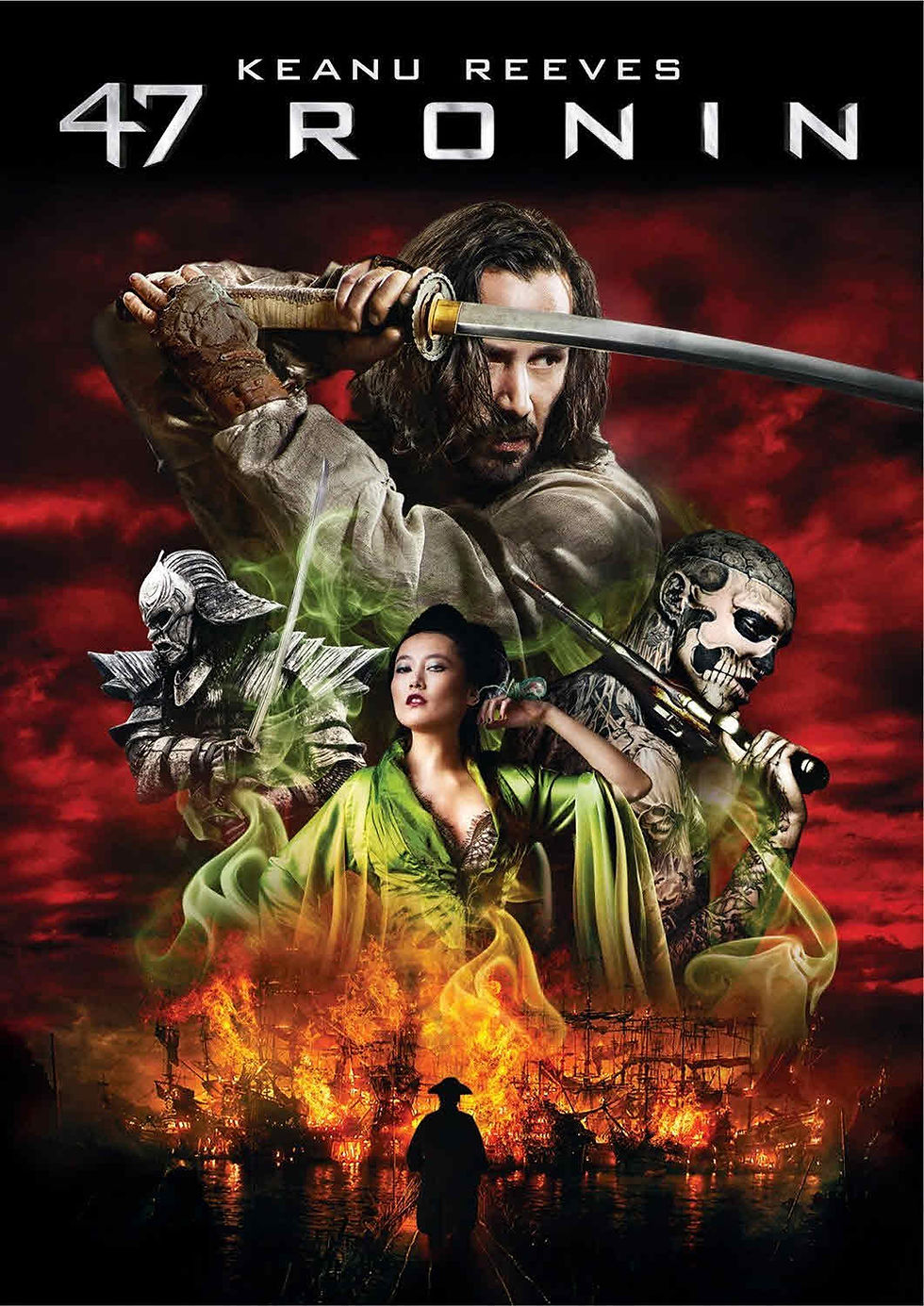
The Kill Bill poster, mixing Bruce Lee's yellow tracksuit with the chanbara katana (top), and the 47 Ronin poster, a representative case of conscripting the samurai as a symbol of Orientalism (bottom).
On the other hand, in a situation where the figure of the samurai is no longer what it was, bushido migrates to objects that are not chanbara. The tokusatsu hero series Kamen Rider (仮面ライダー), begun in 1971, presents—for an older audience than other tokusatsu shows—a dark hero in a style resembling the chanbara film, or the spaghetti Western's outlaw. Some of the series' spin-offs even set out, with an adults-only rating in mind, chanbara-style gore and bloodshed. If inside Japan chanbara mutates into the tokusatsu hero, outside Japan chanbara becomes a representative symbol of Orientalism and Wapanism (the Western fetishization of things Japanese). In the spaghetti Western Red Sun (Sole rosso, 1972), featuring Toshiro Mifune, a samurai appears, out of nowhere, in the Western desert. In The Last Samurai (2003), starring Tom Cruise, the samurai is placed in exactly the position of the Western's "Indian." Tarantino's Kill Bill: Volume 1 (2003), which haphazardly blends chanbara with kung-fu film, blaxploitation, and more, pays homage to everything from Kurosawa's films to Zatoichi, Lady Snowblood (修羅雪姬, 1973), and Tattooed Life (刺靑一代, 1965).[3] Beyond such successful films, there are of course cases like 47 Ronin (2013), starring Keanu Reeves, or the villain "Silver Samurai" in The Wolverine (2013)—but such cases are, so to speak, without end.
So: chanbara has now become a genre, or a representation, unrelated to bushido. What bushido can one feel in the duel between Wolverine and the Silver Samurai? Even if it were the bushido that Inazo Nitobe[4] Orientalistically distorted in Bushido: The Soul of Japan (1899). The bushido-flavored imagery shown by Arasaka in Cyberpunk 2077 (2020), for instance, is nothing more than imagery borrowed. The grotesque form of Adam Smasher, Arasaka's "kagemusha," is already set far apart from anything like bushido. Or take how, in John Wick: Chapter 4 (2023), Caine, played by Donnie Yen, reveals the strange contradiction of being a kung-fu master and at the same time the blind swordsman "Zatoichi." What is emphasized in samurai-led games like Samurai Shodown or Bushido Blade is not bushido but only "chanbara" swordplay and its pleasures. The imagery and characters left behind by the chanbara film keep being broken down into morphemes—mobilized for the genre or concept of the action—and reassembled, over and over.

Adam Smasher, bodyguard of the Japanese corporation Arasaka in Cyberpunk 2077*. The armor encasing his body references the design of samurai armor. The katana in the capture is also a weapon you can make major use of in the game. Personally, I cleared my first playthrough using only the katana….*
At that very point, the two chanbara games made by the American studio Sucker Punch come close to being cases that lay out, just as they are, the complex topography of the genealogy in which "chanbara" sits. Ghost of Tsushima, set in the Kamakura period, takes as its central material the Yuan dynasty's 1274 attempt to subjugate Tsushima. When Tsushima is suddenly overrun and occupied by the Mongol army, the game captures the process by which Jin Sakai—a samurai who alone survives the battle—abandons bushido and becomes the first shinobi (ninja). Because, in the face of the Mongol army's overwhelming force, responding while keeping to bushido is impossible.
In this story, the clichés accumulated in moving between chanbara and Western do not work all that much. The protagonist is not a rōnin or outlaw like Toshiro Mifune or Clint Eastwood, and, depicted as the nephew of the lord who governs Tsushima, he is in his own way a man of power. The only chanbara/Western element within this story, one might say, is the point at which he casts off bushido and becomes a kind of anti-hero, "the Ghost." Its successor Ghost of Yōtei, set in Hokkaido, far more actively draws in a chanbara/Western mood. Music that sounds like Ennio Morricone-style Western scores played on instruments like the shamisen; the vast Hokkaido landscape that has already served as the backdrop for many a Japanese Western; a rōnin protagonist returning home with reasons of her own—from story to setting, in many directions, it evokes the cinematic genealogies mentioned above more than its predecessor did. On top of that, many striking elements are scattered throughout: the "standoff" combat system in both games pulls in the shot composition of the showdown that ran from Yojimbo to A Fistful of Dollars, and so on.
Footage of Ghost of Yōtei played with Kurosawa, Miike, and Watanabe Modes all switched on. A hybrid situation unfolds: a black-and-white screen mimicking a film look, drenched in excessive blood, while jazzy music plays.
But how can the two games be positioned atop the chanbara/Western genealogy described above? Intriguingly, both games reveal their own hybrid identity through the modes they themselves provide. If Ghost of Tsushima has a "Kurosawa Mode" offering a black-and-white image and sound with a texture resembling Akira Kurosawa's films, Ghost of Yōtei has modes taken, respectively, from Takashi Miike of Sukiyaki Western Django and Shinichiro Watanabe of Cowboy Bebop and Samurai Champloo. In Miike Mode the blood and mud spray all the more; in Watanabe Mode the Western-ish music is swapped for lo-fi contemporary music. To play the game with all three modes switched on would be an experience that lets you take in the accumulated genealogy of the chanbara genre all at once. Playing Ghost of Yōtei in that state is quite a chore, admittedly….
Seen from the standpoint of bushido, Jin Sakai of Ghost of Tsushima and Atsu of Ghost of Yōtei are figures converging on a midpoint from opposite directions. Jin Sakai, a samurai grounded in bushido, gradually abandons it after defeat and becomes the first shinobi. Atsu, who burned with vengeance from the start, comes (without becoming a samurai) to understand bushido a little, through her companions the "Wolf Pack" and, above all, through her reunion with Jubei, the twin younger brother she had not known was alive. But this is no more than an alibi to keep the narrative running. To dig deep and analyze these stories is closer to exhuming the stale spirituality called bushido. And what we would then find would likely be a figure like an oni, rotted here and there.
Chanbara = Parrying?
Bushido has been reduced to an object of discard or critique, and the samurai and ninja have been taxidermied—from a thoroughly Orientalist gaze—into mere popular-culture icons. The center of gravity binding them together seems all but gone. So what, then, do the works that can be bound together as "chanbara" have in common? Here we need to return once more to the etymology. It is worth attending to the fact that what audiences went wild for in the early-twentieth-century Japanese costume dramas disparaged as chanbara was, rather than bushido, the swordplay itself. The so-called tachimawari (立ち回り)—the staged melee—comes close to the heart of chanbara. After all, even the etymology of chanbara is the compounding of onomatopoeia depicting blades clashing and blood scattering.


The final duel of Sanjuro (top)—chanbara itself—and a standoff scene from Ghost of Yōtei (bottom).
Translate the onomatopoeia "chanchan barabara" into a game mechanic and you get parrying. Indeed, the game known as the first to feature parrying is the samurai fighting game Samurai Shodown II (真SAMURAI SPIRITS 覇王丸地獄変, 1994). Parrying as a game mechanic then began to be used mainly in fighting games like Killer Instinct 2 (1996) and the Tekken series (鉄拳, 1994–). The technique of parrying itself, of course, existed from the Middle Ages in Western swordsmanship and in sports like fencing; but chanbara's influence is immense in its becoming established as a game mechanic.


Parrying in Samurai Shodown II (top) and a parrying GIF from Sekiro (bottom).
Today parrying can be found not only in fighting games but in nearly every action game—whether the game uses bladed weapons and shields or centers on fists and kicks. Even in a JRPG-style turn-based game like Clair Obscur: Expedition 33 (2025), where combat and magic mingle, parrying has come to be used as the single most important system. What popularized the parry system across action games today was, in all likelihood, the games of FromSoftware. In Dark Souls (2011), the dull sound effect that appeared on a successful parry was essential to the "riposte," the critical follow-up that lets you deal heavy damage. But befitting a game famous for its punishing difficulty, from Dark Souls through Elden Ring (2022) parrying was less a tool every player needed than an optional play-style for veterans. The intriguing case is Sekiro. While it keeps its distance from FromSoftware's orthodox Souls line, in this game—which foregrounds a single weapon and a Posture system—the single most important action is parrying. Memorizing the enemy's attack patterns wholesale and knocking them back (in-game the action is rendered not as "parry" but as "deflect") makes up most of the action, to the point where players call it a rhythm game. The method of filling the enemy's Posture gauge through deflects, breaking their stance, and landing a single blow left as strong an impression as the Dark Souls series, and created a fad of another kind. What is more, the "shinobi-kill" (忍殺) Deathblow—dispatching the opponent with a single strike after trading blows blade to blade—immediately evokes the iconic final scene of Sanjuro.

Parrying in Ghost of Yōtei.
Ghost of Tsushima, too, adopts a similar system. Of course, since its release date is only about a year apart from Sekiro's, there would not have been enough time to borrow Sekiro's system directly. But Ghost of Tsushima likewise has nearly the same construction of action mechanic—breaking the opponent's stance through a parry and landing a single blow. The differences are only that it has more moments of one-against-many combat than Sekiro, and that the action is built around learning various swordsmanship stances and responding according to the opponent's weapon (katana, spear, shield, and so on). This is not greatly different in Ghost of Yōtei; the only difference is that Jin Sakai's various swordsmanship stances are replaced, for Atsu, by various weapons—the ōdachi, the kusarigama, the spear, the dual blades, and more.
In the "standoff," one of the game's systems, the figures of protagonist and enemy glaring at each other belong to chanbara but at the same time to the Western. From the vantage of the 2020s it is impossible to tell them apart. That the stages of both games handle regions outside Japan's "mainland"—Tsushima and Hokkaido—is surely a clear Western influence. Ghost of Tsushima, which chooses the thirteenth century rather than the Sengoku era, and Ghost of Yōtei, which treats the Sengoku era and mentions great battles like Sekigahara yet stands one step removed from their center, draw in the Western by way of avoiding the chanbara film's two principal settings (the Sengoku era and the Edo shogunate). What makes the two games chanbara, though, is that their action follows the parry-based manner of the chanbara film. That parrying as a game mechanic emerged under chanbara's influence, the two games faithfully inherit. So, in the end, the core of the two games is this: that they are swordfighting games.


From top: the final duel of Yojimbo, the duel of The Good, the Bad and the Ugly (1966), and a standoff scene from Ghost of Tsushima. The similarity of composition runs through them.
Merely by richly providing the pleasure of action one can expect from a chanbara action game, the two games are a success. The Western-style atmosphere that settled into Hokkaido by way of the spaghetti Western from chanbara, the narrative of a wandering, outlaw anti-hero—these are no more than a set of shells needed to render chanbara action vividly. Picked apart in detail, these shells are not even sufficiently "real." The Yuan subjugation of Tsushima, the chief motif of Ghost of Tsushima, involved not only Mongol forces but Goryeo (Korean) troops, who do not appear in the game. The design of Jin Sakai's armor and katana follows the Sengoku era rather than the thirteenth-century Kamakura era—because that is the image of the samurai more familiar to those who will play the game. That Ghost of Yōtei, unlike other games set in the Sengoku era, takes Hokkaido as its stage is to present a plausible backdrop for a lone individual, Atsu, to defeat the Saitō clan and the Yōtei Six; beyond that, a reason is hard to find. The construction of the finished game comes closer to the result of selecting the options through which a fitting chanbara-action tachimawari can be played and felt via the PlayStation DualShock/DualSense.
In that context, atop the genealogy that the genre named "chanbara" has formed across all sorts of media, Ghost of Tsushima and Ghost of Yōtei are, paradoxically, composed of elements that lay out one by one the path chanbara has traveled. The traces of bushido as a national project; the motifs and clichés developed in exchange with the Western; parrying, the chanbara of game mechanics. Chanbara is a genre of the Japanese popular-culture tradition and, at the same time, has become a cultural icon whose traces can be found in any country on earth. At any rate, the two works—American games both—confirm this anew.
[1] Kim Ryeo-sil, Ilbon yeonghwa-wa naesyeoneollijeum [Japanese Cinema and Nationalism] (Seoul: Chaeksesang, 2005), 28.
[2] As an aside, the Japanese release of this film is said to have ended with Zatoichi's victory, while the Hong Kong release ended with the One-Armed Swordsman's.
[3] Strictly speaking, the protagonist is a yakuza rather than a samurai, but the swordfight of the latter half, captured in long takes, can be said to follow the chanbara template.
[4] A Japanese thinker, educator, and statesman, known as an internationalist who worked toward Japan's modernization in the Meiji era; he was also the figure depicted on the old 5,000-yen note.
Tags:
글이 맘에 드셨다면 공유해보세요.

Majored in art studies as an undergraduate and is currently studying media cultural studies at the Graduate School of Communication, Yonsei University. Writes primarily about film, while keeping a curious eye on visual culture broadly—art, games, and broadcasting among them. Also a film critic, host of the podcast Café Critique, and an organizer of community film screenings.
