
The Unclear “Subculture Game,” the Clear “Business of the Heart”
32
GG Vol.
26. 10. 10.
“The Home Ground of Subculture”
This past September, the Tokyo Game Show closed to great success. Sudden typhoon news ended the event a day early, against the original schedule, but with 1,138 companies and organizations from 53 countries and regions it set a record for scale. Visitors over the four days numbered 257,642 — a slight dip from the previous year, the result of the final day’s outright cancellation.
Whether in the wake of China–Japan tensions or not, the major Chinese game companies long aggressive in the Japanese market — Tencent, NetEase, HoYoverse — set up no booths at Makuhari Messe this year. Taking their place were Korean game companies that chose the Tokyo Game Show over G-STAR. Nexon Games brought Pareidolia, NCSOFT brought Astrae Oratio, and Smilegate brought Miraesi: The Unseen Future. All of these games were classed as “subculture.”
The Korean press on the scene analyzed that “the judgment was that recognition in Japan, the home ground of subculture, would smooth global expansion,” or relayed the buoyant mood — “the power of K-games confirmed in subculture’s home ground, Japan.”
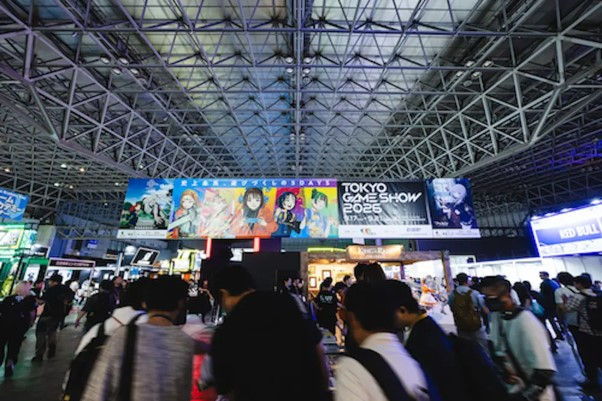
[Photo] Tokyo Game Show 2026, where Korean game companies turned out in force (source: CESA)
Quite apart from these games’ craft or popularity, a question mark attaches to the phrase “the home ground of subculture.” The game ecosystem has for quite a while now appropriated the concept-word subculture for itself. The appropriation is not wholly bad: many games take subculture in as a kind of idiom, and no small number of people enjoy playing them. Like the countless games that will pass through a reader’s mind, the fusion is a fitting enough match. But this “subculture game” has lately been so overused as to breed the misunderstanding that subculture simply is games.
Subculture is an enormously complicated concept-word. In the past it named a lower culture set against the mainstream. From the 1950s, sociologists of culture defined subculture as “an identifiable subgroup within a society or group, especially one with beliefs or interests at variance with those of the larger group; the distinctive ideas, practices, or way of life of such a subgroup.” Young people with nothing much to do gathering in back alleys and clubs, sharing the same music and fashion and forging an identity — that was the original form of the phenomenon the word pointed to. By that genealogy, subculture’s home ground is not Japan but the England of the mods, or the America of graffiti. Even in Japan the situation differs: sabukaru, the Japanese word for subculture, has since the 1980s named a lineage of people distinguishing themselves by tastes in magazines, music, and film — a current distinct from otaku culture.
Today in Korea, however, subculture is in many cases used to designate Japanese animation and its derivative content. HoYoverse, at the front of the “subculture game” field, is estimated to have earned, in 2025 alone, $420 million from Honkai: Star Rail, $329 million from Genshin Impact, and $166.5 million from Zenless Zone Zero[1]. Even granting that revenue is not the index that explains everything, the retort follows naturally: should cultural content raking in this much money in a single year not be called pop culture rather than subculture?
The Korean companies that came to the Tokyo Game Show of the “home ground” will also be aiming at revenues that exceed the “sub,” if not at HoYoverse’s scale. Baek Young-hoon, Smilegate’s Chief Business Officer, said in a TGS interview that “the market itself has grown too large for the term subculture to be appropriate”[2].
What Is a Subculture Game?
How fast, then, is this “market” growing — too large to be fittingly called subculture?
The figures differ report by report, but one thing is clear: the market points up and to the right by the day. The Nikkei reported that the market for oshikatsu — supporting one’s favorite idol, actor, or character and consuming the attendant content and goods — has reached 3.8 trillion yen (about 36 trillion won)[3]. In a Nomura Research Institute survey, the oshikatsu population among Japanese aged 15 to 69 came to roughly 26 million — past 30 percent of that age range. In 2025, Anime Expo, the largest subculture event in the United States, drew a record 410,000-plus visitors from 65 countries and generated an economic ripple of $110 million (about 152.3 billion won)[4].
Korean indicators show the same current. AK Plaza’s Hongdae branch, which in 2021 renewed its whole store as a space specialized for enthusiasts, brought in an animation specialty shop, capsule-toy stores, and claw-machine shops for popular IP in succession, and came to be called a “subculture mecca.” Sales of 27.7 billion won in the first renewal year reached 98.2 billion in 2025 — 3.5 times over[5]. Aekyung Group, which built AK Plaza, transplanted the model to its Suwon branch, opening a permanent IP content space of some 2,000 square meters. In the Hongdae district, gacha shops, goods shops, and maid cafes spring up like mushrooms, a new one every other day.
It is within this explosive swelling of otaku-adjacent markets that the concept-word “subculture game” was invented. No dictionary definition or scholarly consensus exists for it, yet in the industry the term clearly designates something. Skim the postings on a game-industry job board and you meet sentences like: “Experience developing and operating subculture games preferred.” The writer of the posting, and the applicant submitting a résumé, both presuppose that each knows what a subculture game refers to. So with brokerage reports: analysts describe a given company as “a leader in domestic subculture games” and call a title in development “a new subculture IP.” That a broadly current conception of the subculture game circulates in the industry is hard to deny.
And yet the subculture game remains an unfamiliar classification. Korea’s Game White Paper divides genre into items like RPG, action, shooting, simulation, sports, puzzle. Ratings classification looks only at levels of sexual content, violence, crime, drugs, language, and gambling. The standard industrial classification has no separate concept for subculture either. Global app markets likewise sort by role-playing, action, simulation, casual.
The name differs market by market. The same kind of game is called “two-dimensional games” (二次元游戏) in China, and “gacha games” or “anime games” in the West. Some reports deploy the term ACG (animation, comics, games). According to Kim Hyung-tae, head of Shift Up, “in Japan the very word for the concept of subculture or 2D games does not exist” — “because content of that kind is most of what there is”[6]. If a Korean representative at an overseas game show said “we make subculture games,” the buyer would tilt their head: for them, games as a whole are already subculture — or they have their own word, “anime games.”
Nor can it be bound by mode of play. What is called a subculture game may be a collection RPG, a shooter, a rhythm game. Is it the art style, then? That explanation does not last either. The 2D illustration of Blue Archive and the photoreal-leaning 3D of Love and Deepspace differ utterly in style, yet both are classed as subculture games. Are Mabinogi Mobile or Cookie Run subculture games?
What, then, is this broadly current conception? It will differ a little from game to game, but roughly these traits are named: ⓐ character collection as part of building one’s roster, sold in the form of randomized (loot-box) items; ⓑ the formation of an attachment relation between character and player. (Put in the terms of Blue Archive producer Kim Yong-ha’s “moe theory”[7], this would be the game’s provision of “an integrated context that stimulates the imagination.”) The two are not so separable, and tend to be presented together with operational elements — repeatable content, seasonal limited goods, offline events. After Genshin Impact’s great success, subculture games borrowing the open-world grammar (the “Genshin-like”) drew their own popularity.
Armed with this “conception,” the subculture game has been advanced in the industry as a persuasive course, and has drawn no small popularity in the mobile market. And so the Korean market has come to understand the subculture game as, roughly, “a collection RPG led by anime-style art.” One ends up wondering whether the tug-of-war between BM and attachment is not, in the end, the whole of the subculture game.

[Photo] Umamusume: Pretty Derby (subtitle omitted hereafter), a representative example of the “collection RPG led by anime-style art” (source: Cygames)
The Business of the Heart[8]
To sum up the discussion so far: in Korea, subculture is being used as another name for otaku culture. Just as, in the cinephile’s world, “mise-en-scène” is more “elegant” than “shot composition,” the subculture game is a different way of saying the otaku game. By this choice, speakers can wipe away the negative schema lodged in the word otaku.
Gather well, through games, the “taste communities of the ‘periphery,’” and “diverse cultures”[9] bloom within — and that this leads straight to revenue was proven by those who declared “Tech Otakus Save the World”[10]. So strong was the ripple of that proof that subculture in its older sense — the lower culture set against the mainstream — now seems scarcely ever to be called by name.
At this point I want to make two observations.
One: whether you view the subculture game through the frame of “subculture” or the frame of “the game” can yield very different results. As a game, Umamusume adopts a simple structure: repeat training and races within a set period and contend for rank. The fruit of the raising is represented only by quantified stats, and can be inherited through a set process. Read the racehorses “only” as collectible characters and that is what you get — but read Umamusume as a growth drama modeled on real racehorses, and an entirely different context unfolds. In the course of a character communing with the player through the story, and running again the races already run, attachment buds[11] — and there Umamusume’s true worth comes to light.
Subculture as an industry is, in the end, a “business of the heart.” This business is the process of making fans, not consumers — an ultra-long-distance marathon, not a single bout. How a “fan” whose heart has turned can change — the trucks and funeral wreaths dispatched across the K-pop and gaming scenes give some idea. This “heart” can grow past simple consumption into the desire to make something of one’s own — and so “fan works” are born[12].
Two: as this “heart” is individualized and fragmented, one comes to ask whether the word “subculture” as a term of cultural sociology is not itself gradually losing meaning. The most-watched television program in Korean living rooms this past Chuseok was the concert broadcast marking singer Lee Seung-chul’s fortieth anniversary — peak per-minute rating: all of 6.1 percent. I myself, watching Korea’s football friendly against Ecuador on Coupang Play — uncounted in TV ratings — had no idea Lee Seung-chul was singing. The Aichi-Nagoya Asian Games were in full swing the same week, and the holiday brought The Intern, A Love That’s Possible, Assassin(s), and Tazza: The Song of Beelzebub to theaters — but for someone out there, the sole object of interest was The Secret of Mermaid Island. Which is the name of the Chiikawa movie.

[Photo] Chiikawa the Movie: The Secret of Mermaid Island. Never having seen characters that look like this is nothing to be ashamed of. (source: CJ ENM)
Mass popular culture has not vanished outright, of course. Try ticketing for a BTS or Lim Young-woong concert and you will feel its force keenly enough; as KPop Demon Hunters showed, the mega-hit still appears even in a fragmented age. What has vanished is subordination to popular culture. The era of hurrying home to catch Sandglass is gone. Made in Korea 2 can be watched anytime, anywhere on Disney+, and not watching it today poses no particular obstacle to everyday conversation.
It is a world where watching the “twenty-minute recap” is fine — and not watching KPop Demon Hunters at all is fine too. Everyone now moves along the line of their own taste. It is not the era of one content watched by ten million, but of a hundred contents, each watched by a hundred thousand, floating like islands. As Google removed the trending tab from YouTube, weighing contents against each other for rank is no longer much of a valid exercise: there is not one scale now, but many. Where there is no hierarchy of mainstream and sub, “sub” tells you nothing about size.
And yet the industry uses the word with relish. It earns pop-culture money, dreams pop-culture dreams — and clings to the word sub, presumably because subculture itself has come to mean a certain way of earning money through the business of the heart. The structure in which the price of fun is paid once — the movie ticket, the packaged game — differs from the structure of spending repeatedly, for a beloved object, without knowing what will come out. The random photocard slipped into a K-pop album and the random-box figure at a Hongdae gacha shop both use this same technique. Some of it is called subculture and some is not, but the way the money circulates is remarkably alike.
The heart, as a rule, yields entirely different values depending on how it is measured. Measure the same game in numbers and it is grinding; measure it in attachment and it is keeping my character alive. If there is such a thing as “the home ground of subculture,” then, it will be found not in any country or market but in your own heart. In the business of the heart, the companies and developers who saw through this have stood out in the market — and will go on doing so.
[1] “2025 Subculture Revenue TOP 10: HoYoverse Dominates, NIKKE 7th,” Gamelook, Jan. 5, 2026.
[2] “Baek Young-hoon, Smilegate CBO: ‘The Market Has Grown Too Large to Call Subculture,’” Kukmin Ilbo (Lee Daniel), Sep. 19, 2026.
[3] 推し活、物価高何のその 3人に1人、市場は3.8兆円 中高年の消費旺盛 (니혼게자이신문, 26-04-05)
[4] https://www.anime-expo.org/2025/07/14/anime-expo-2025-wraps-four-days-of-celebration-with-attendees-from-over-65-countries-1300-hours-of-programming-and-discussions-on-its-future/
[5] “The Otaku Flocked In — and the ‘Hongdae Mecca’ Hit a 98.2-Billion-Won Jackpot,” Hankyung (Park Sang-kyung), Jun. 19, 2026.
[6] “[Interview] Kim Hyung-tae Discovered ‘Love,’” Inven (Lee Du-hyun), Sep. 29, 2024.
[7]Kim Yong-ha, NDC 2014 (https://ndcreplay.nexon.com/NDC2014/sessions/NDC2014_0015.html#k%5B%5D=%EA%B9%80%EC%9A%A9%ED%95%98)
[8] “The Business of the Heart” (마음의 비즈니스) is also the title of a book by the content-industry analyst Cha Woo-jin.
[9] Kang Shin-kyu, Subculture Criticism (서브컬처 비평), 2021.
[10] “Tech Otakus Save the World” is HoYoverse’s founding creed and slogan.
[11] “Two Forms in Which Love Is Represented in Games: Narcissism and Attachment,” GameGeneration Issue 16, Prof. Lee Jung-yup.
[12] The author handles external relations at a company operating a fan-works brokerage platform.
Tags:
서브컬처 게임, 서브컬처, 오타쿠 문화, 수집형 RPG, 가챠, 도쿄게임쇼, 우마무스메, 마음의 비즈니스, Subculture Games, Gacha Games, Anime Games, Tokyo Game Show
글이 맘에 드셨다면 공유해보세요.

