
Welcome to the Nomi Cup: The Greatest Wa-gall Cooking Contest Under Heaven
30
GG Vol.
26. 6. 10.
1. The Cake Was a Lie
The cake is a lie. Anyone who has played Portal cannot help but know this line. The game's AI, GLaDOS, promised the player a cake as a reward for clearing every test chamber—but the offer was false. More precisely, the cake exists; it merely sits in a room the player can never enter. After this mischievous scene, some players began, in earnest, to bake the cake beyond the screen—the Black Forest cake. Piecing together the fragments of a recipe that had flickered past on the monitor, they baked it and posted the photos. GLaDOS's cake was a lie, but it did not stay a lie forever.
There is no need to confine this to Portal. Food in games always sits in a slightly strange place. The red potion in Diablo is reduced to a number called health recovery; a slice of bread in World of Warcraft is a utility icon that raises your stats for a set time; and even the cooking cutscene that fills the screen when Link tosses ingredients into a pot in The Legend of Zelda is filed away into an inventory slot bearing nutritional data. In every case, food in a game can be seen but not eaten. This mismatch is the engine that gave rise to a publishing genre: the game cookbook.
Over the past decade, quite a few such books have appeared in the English-language market. A Fallout cookbook, a Final Fantasy cookbook, an Assassin's Creed cookbook, a Genshin Impact cookbook. Each cover bears the game's logo; the photographs make the in-game food look like real food; and inside, the recipes are packed tight. The standard-bearer of the genre is World of Warcraft: The Official Cookbook, written by Chelsea Monroe-Cassel. As a physical object the book is, first of all, hefty. The cover carries the game logo in WoW's signature deep gold and blue. By any measure it looks like game merchandise. And yet, turning the pages, you come away with the impression that this is not mere merchandise but the product of someone who loves the world of WoW, makes its food, and has bound the results together. The media scholar Nicolle Lamerichs once described the act of a fan making and eating in-game food in their own kitchen as "truly beating GLaDOS." The Official Cookbook is what happens when that act is set down as a single publication.

2. The World the Headnotes Make
What decisively separates this book from other cookbooks is not the recipes but the short headnotes set above them. In an ordinary cookbook, the headnote is where you record a dish's origin, the author's reminiscences, points to watch while cooking. But the headnotes in this book keep quietly calling out names unfamiliar to anyone who doesn't play WoW. Turn the pages and you run into sentences like these:
"Just don't touch the Hozen's Weeping Soup."
"What more need be said, when red bean buns are Li Li Stormstout's favorite snack!"
"Jaina Proudmoore, who is helpless before goat cheese, would surely agree."
"The simplest of the recipes personally taught by Ansel Iron-Paw, that master of the stir-fry, is sautéed carrots."
"This Undercity snack is the Horde races' favorite food."
A reader who has played WoW will recognize at once who these names are. Li Li Stormstout is a central figure in the Mists of Pandaria expansion; Jaina Proudmoore is one of the Alliance's most famous heroes. Ansel Iron-Paw and Abigail Shiel are trainer NPCs who teach the cooking skill inside the game. The headnotes are summoning figures who actually exist within the world of WoW into kitchen banter.
Game merchandise—character figures, illustration artbooks, soundtracks—shows objects of the game world from within the real world. The viewer plainly stands in the real world, and the game is somewhere beyond. But this book's headnotes strangely blur that distance. The moment it writes "Jaina, too, would agree," the book's narrator summons Jaina as though she were someone the reader knows, or a well-known gourmet friend. The narrator is not a guide from the real world but someone within the WoW world who naturally knows who Jaina is. Other headnotes reinforce the impression:
"Unlike the original recipe that came from Kalimdor's Dustwallow Marsh, this one requires no harming of dragons at all." — Dragonbreath Chili
"The fishermen of Westfall's original recipe is, by every measure, the best." — Clam Chowder
"This was once a staple eaten only by the Tauren tribes of the Mulgore region." — Corn Mana Bread
"Stuffed Lushrooms, once a favorite of the ancient Mogu, have now settled in as a representative Pandaren dish." — Stuffed Lushrooms
"The original recipe," "once eaten only by such-and-such a people," "has now become so-and-so's representative dish." These phrasings belong less to a cookbook than to the register of a food historian. Each dish has a birthplace, a history of transmission between peoples, and a present standing. The headnotes speak as if the world of WoW had a real history of foodways—as if some scholar of that world, or some diligent innkeeper, had compiled a book of their world's foods, and the reader were now reading it. And when you reach the headnote for the sweet-and-sour cranberry sauce, the impression sets firmly:
"This is the Pilgrim's Bounty sauce whose recipe appeared in The Bountiful Cookbook. In the past, the recipe could not be obtained anywhere outside Azeroth."
The book is citing another book within itself. The statement is that a book called The Bountiful Cookbook exists inside Azeroth, and that this sauce's recipe appeared in it. Which is to say: the WoW cookbook the reader is now holding belongs to the same lineage as the other cookbooks of Azeroth. The line "in the past the recipe could not be obtained anywhere outside Azeroth" is the proof of that pretense. The implication runs beneath it that this very book is the first to carry the recipe somewhere beyond.
This pretense is held consistently. The headnote for Tracker Snacks reads, "It will surely help in tracking down hard-to-find companion pets." It is a joke about the in-game mechanic by which a WoW hunter commands pets, but the joke's narrator treats that mechanic as if it were common knowledge. The headnote for the Herb Baked Egg runs, "It can be made fairly easily and quickly, making it just right as practice for a cook who wants to raise their skill." It states, as if it were ordinary culinary common sense, the fact that this is a practice dish you make when leveling up the cooking skill inside WoW. The headnote for honeymoss reads, "You can usually buy it from mushroom vendors, but now you can make it yourself, too." "You can usually buy it from mushroom vendors" is common knowledge in Azeroth; "now you can make it yourself, too" explains the book's reason for being. The cookbook pretends to be the book that first teaches Azeroth's food to people outside Azeroth.
This pretense subtly shifts the reader's position. The reader stands in the kitchen holding a Korean-language hardcover. Yet the moment the book is opened, for a short while they become someone leafing through a cookbook just published by some innkeeper of Azeroth. They are warned not to touch the Hozen's Weeping Soup, they learn which cheese Jaina likes, they learn how a mushroom the Mogu once ate became Pandaren food. For that brief moment, the kitchen is the reader's home and, at the same time, somewhere in Azeroth.
3. The Apprentice Cook's Kitchen
If the headnotes carry the reader into Azeroth, then how do the book's format and visual design assign the reader a place within it?
Consider first the book's structure. The chapters are divided by type of food: sides, breads, soups and stews, mains, desserts, drinks. A familiar classification you might find in any Western cookbook. The Horde and Alliance factions are scattered into the headnotes we saw earlier. Kaldorei pine nut bread is Night Elf (Alliance) food; Mulgore spice bread is Tauren (Horde) food; Pandaren plum wine is the food of a neutral race that has left the factions behind. Like the origin label on a wine, faction survives as a marker of flavor and provenance.
What governs the book's structure instead is something else. Each chapter carries a subtitle. Sides is "The Way of the Snack," breads "The Way of Bread," soups and stews "The Way of the Broth," mains "The Way of the Main Course," desserts "The Way of the Dessert," drinks "The Way of the Drink." This naming borrows the in-game cooking-specialization system introduced in the Mists of Pandaria expansion. The system by which you chose how to specialize your character's cooking skill in the game becomes, inside the book, the system by which the reader chooses which kind of dish to begin with.
Turn a few more pages and still more game interface is printed there. Every recipe has a proficiency label at the top, marked as one of apprentice, expert, or master—a classification modeled on the in-game cooking-skill tiers. At the start of each chapter there is, helpfully, an achievement guide: a marker lifted straight from the game system, noting that making five recipes from each Way unlocks an achievement. Each recipe carries a "pairs well with" entry telling you which other dish to match it with, and some recipes add a "can be used in" entry telling you which other dish this food becomes an ingredient for. WoW's crafting system, in other words, is sprinkled in small type throughout the book.
What the book imitates is not only WoW's worldbuilding but WoW's system itself. Chopping an onion becomes an apprentice-tier act, and completing five bread recipes becomes the achievement of "The Way of Bread." If the headnotes whisper to the reader that they have entered Azeroth, the interface tells them that within it they have been given the post of apprentice cook.
The photographs perform the same work in another way. Every recipe is accompanied by a full-page photograph, and those photographs come close to natural light. Light falling softly from one side casts the food's surface into slight shadow, and a warm yellow tone wraps the whole frame. Beside the food sit ordinary kitchen tools—wooden cutting boards, cast-iron pans, ceramic bowls—joined by medieval-flavored props such as coarse linen, a copper kettle, parchment bound in leather.
Look closely, though, and things are tucked quietly into the photographs. A single weapon lies blurred behind the food, or a pewter beer stein appears alongside it. Take the photograph of the seasoned jerky: beside the food are vines that evoke a campsite, arranged together with a wooden board, a knife, and a whetstone. These small details change the photograph's meaning. The seasoned jerky is no longer simply a well-shot dish but food that someone might have eaten while tending their weapons at a campsite. A reader who has played WoW summons that campsite without difficulty—some desolate plain in Kalimdor, or some forest in the Eastern Kingdoms.

The pen drawing on the page facing the food photograph does the same work. The pen drawing depicts not the food itself but the scenery the food calls to mind. Beside a seafood dish, a ship in harbor; beside a meat dish, a warrior. The pen drawing helps from the side, telling us at whose table, in which world, the food is set. The photograph makes the food feel real; the pen drawing evokes the world the food belongs to.
It is worth noting that these photographs sit in a slightly different place from ordinary food photography. Food photography is usually shot to stir appetite. Its aim is to make food alluring, glistening, something you want to eat. But the photographs in the WoW cookbook are faithful less to appetite than to circumstance—to the circumstance of where, in the world of WoW, this food is set, and beside whose hand and weapon and campsite. This is also why the photographs do not mimic the color of the game screen. Had the photographs looked like the game screen, the food would still be food beyond the screen. The moment the photographs adopt natural light and ordinary kitchen tools but set a blurred weapon beside them, the food becomes, at last, something you can make in your own kitchen—and, at the same time, something someone might have eaten at a campsite in Azeroth.
The book, then, runs three devices at once. The headnotes seat the reader in the place of someone within Azeroth; the interface grants that place the post of apprentice cook; the photographs and pen drawings show the circumstance in which the food made in that post is set. When the three work together within a single page, the book becomes not a mere cookbook but a device that carries an entire world into the kitchen.
4. The Fallout Cookbook, Annotated by a Survivor
This pretense is not the WoW cookbook's alone. The genre of the game cookbook shares a similar circuit of pretense. Among them, Fallout: The Vault Dweller's Official Cookbook, written by Victoria Rosenthal, is strangely similar to the WoW cookbook and yet decisively different at one point.
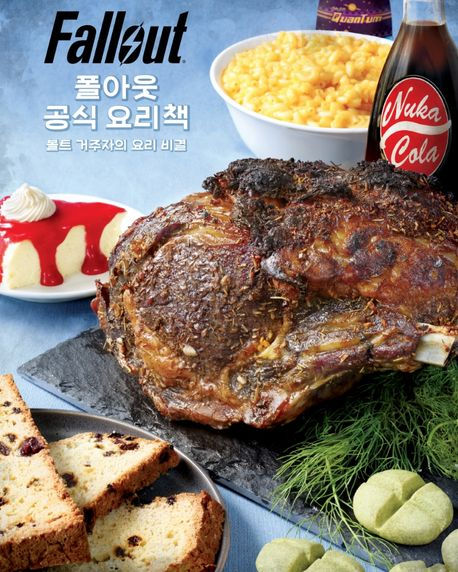
The introduction opens like this: "Welcome to the Vault-Tec life! We understand the difficulty of the transition that comes from the fact that the world you knew has—if you are reading this—surely met its end." In the Fallout universe, Vault-Tec is the company that operates vast underground fallout-shelter facilities in preparation for nuclear war. The game's player character wakes in one of those shelters and steps out into the post-nuclear wasteland to begin their adventure. The book pretends to be a cookbook that Vault-Tec issued to shelter residents as a move-in guide. If the WoW cookbook pretends to be a book published by some foodways scholar of Azeroth, the Fallout cookbook pretends to be a lifestyle pamphlet that an American corporation, just before the nuclear war, handed out to its customers.
This pretense is held consistently throughout the book. After the introduction come sections like "Entertaining the Vault-Tec Way" and "Dietary Restrictions Guide." The entertaining section reads: "Gatherings exceeding eight people require separate paperwork. Please bear in mind that kitchen use is a privilege that may be revoked at any time." The dietary-restrictions section delivers guidance for vegetarian, gluten-allergy, and lactose-intolerance needs in the tone of a company newsletter. "We have far too much margarine in stock—please, take some! We need the space for oxygen tanks." Jokes like these build the book's context and nuance. The atmosphere of the Fallout world—the manual of an authoritarian corporation that controls and surveils its residents—is compressed into a single cookbook.
But the book's sophistication lies in what comes next. A second narrator breaks in by hand. Beside recipes printed as official company text, notes are added here and there, as though someone had scribbled in the book in pencil. Beside the chicken-stock recipe, for instance, is this handwritten note: "Radioactive chickens are easy to catch, but they can be very fast, so approach with care." In the post-nuclear wasteland there are no ordinary chickens, so you must hunt mutated, radiation-exposed ones—that is the note. Above the bacon-wrapped scallops recipe, someone has rewritten the title as "Mystery Meat Nuka-Lurk" and left this note beside it: "Got the mystery bacon from the Misers of Nuka-World. Never saw a single pig there." Beside the Deathclaw omelet recipe is written: "Chicken eggs don't just roll around. But Deathclaw nests are everywhere. Substitute two Deathclaw eggs for six regular eggs."
The narrator of these handwritten notes is a survivor wandering the post-nuclear wasteland, adding their own experience on top of the company's manual. They keep the chicken-stock recipe Vault-Tec taught them, but leave a note on the reality that, after the nuclear war, there are no chickens and so one must substitute the egg of the Fallout world's giant lizard-like monster. The survivor's practical tone is layered over the company's authoritarian tone. Within a single book, two narrators, two timeframes, and two tones coexist.

The effect this dual-narrator structure creates is powerful. If the WoW cookbook holds a single pretense consistently, the Fallout cookbook runs two pretenses at once: the authoritarian corporation before the war, and the lonely survivor after it. The reader who opens the book finds themselves wedged between these two timeframes—the placid domestic life the company promised, and the reality of a survivor cracking Deathclaw eggs in the ruins where that promise collapsed. The 1950s-style optimism of prewar America that Fallout takes up, and the dystopia after it has turned to rubble, are compressed into a single cookbook through two narrators.
This book, too, transplants the in-game system as is. Each recipe lists the S.P.E.C.I.A.L. stat effect you gain from eating the dish. S.P.E.C.I.A.L. is the acronym—Strength, Perception, Endurance, Charisma, Intelligence, Agility, Luck—by which a character's stats are determined inside Fallout. Make and eat the Deathclaw omelet and you get Intelligence +1 for one hour; add a glass of Nuka-Cola and you get Endurance +1 for thirty minutes, and so on. If the apprentice/master tiers of the WoW cookbook gamify the act of cooking, the S.P.E.C.I.A.L. effects of the Fallout cookbook turn the food itself into a game item. Every dish made in the kitchen becomes food that nudges one of your stats up a little, somewhere.
Set the WoW cookbook and the Fallout cookbook side by side and it becomes clear that the two pretend in exactly opposite directions within the same circuit. The WoW cookbook's pretense is warm: the summons not to touch the Hozen's Weeping Soup, the joke about the cheese Jaina likes, the history of a mushroom dish transmitted from the Mogu to the Pandaren. Inside that pretense, Azeroth looks like a world not bad to live in. The Fallout cookbook's pretense, by contrast, is cold: the manual of a company that surveils its residents, the notes of a survivor who must make food from Deathclaw eggs after nuclear war. Inside that pretense, the Fallout world is a world hard to survive in. Both books carry the kitchen into another world, but the grain runs in opposite directions.
5. Nomi's Recipes, Heir to The Other Cookbook
The WoW cookbook has a sequel. Chelsea Monroe-Cassel's World of Warcraft: New Flavors of Azeroth – The Official Cookbook is the second volume in the series, holding some seventy recipes. Lay this second volume open alongside the first and you see how far Monroe-Cassel pushed the pretense she began in volume one.
The decisive change in volume two is the narrator. If the narrator of volume one introduced the food like some foodways scholar who knows the WoW world, in volume two a clear name is fixed to that place: the Pandaren chef Nomi. Nomi is an NPC who runs a small cooking school in Halfhill, a town of the Pandaria expansion—a character famous in-game for taking your ingredients and then burning them, again and again. It is this Nomi who has published a book that opens with the recollection: "When I spent my childhood in Pandaria, I wanted to learn everything about cooking."
Monroe-Cassel has explained the meaning of the change on her personal blog. Unlike volume one, volume two was made as a book from within the game's world—intended as a book you might pick up as part of some quest inside the game. The pretense that volume one's headnotes had quietly scattered—speaking as if the book were published by some foodways scholar within Azeroth—becomes, in volume two, the book's explicit and consistent premise. Open the cover and from there the reader is holding Nomi's book.
The pretense is voiced throughout the book. The chapter divisions have changed, too. Where volume one was divided by food type—sides, mains, desserts—volume two is divided by region: Kalimdor, the Broken Isles, the Eastern Kingdoms, Kul Tiras, Zuldazar, Pandaria, the Shadowlands, Nazjatar, Northrend, Outland, and beyond. These are the places Nomi has traveled. The headnotes are voiced in Nomi's first-person recollection, and small boxes labeled "Nomi's Note" break in throughout the book, adding glosses to the main text. Beside the Darkmoon Doughnut entry follows Nomi's note, "Craving something sweet?" Both the main text and the notes above it are written by Nomi—so within this one book Nomi occupies, at once, the place of the chef who writes the text and the friend who scribbles a familiar gloss above it. Monroe-Cassel also keeps alive, as a running joke, the reputation Nomi had in the game: throughout the book, Nomi stresses tips on "how not to burn your food."
One more small change in volume two is that the proficiency grades are more finely divided. What volume one split into only three stages—apprentice, expert, master—volume two unfolds into five: basic cooking, apprentice cooking, skilled cooking, expert cooking, and master of cooking. Volume two's position as a book from within the game world has affected even the thickness of the grade classification.
The title of one section near the front of volume two's table of contents is especially interesting: "About the Other Cookbook." Nomi directly summons, within her own book, another cookbook published earlier. She knows her book is the second volume in a series, and she opens by summoning the existence of volume one as an object within her own world. The possibility that another book might exist inside the book—which volume one had left ajar with the single line in the sweet-and-sour cranberry sauce's headnote, "whose recipe appeared in The Bountiful Cookbook"—becomes, in volume two, the premise of the book itself.
The self-reference does not stop at summoning. Volume two sets volume one's recipes and its own recipes on the same table. Look at one dinner-menu recommendation in the text: "Steak à la Mode (p. 141), Peanut Beer Bread (p. 115), Sliced Zangar Caps (Other Cookbook), Sautéed Carrots (Other Cookbook)." The two dishes written with page numbers are recipes within this book; the two marked with the abbreviation "Other Cookbook" are recipes from volume one. The sautéed carrots "personally taught by Ansel Iron-Paw, that master of the stir-fry," quoted near the start of this column, are summoned again here. Volume one and volume two are not books standing apart. They are two sister books laid open on the same table, and Nomi serves the dishes of both at her own table together.
The festival section is part of the pretense, too. Near the front of volume two is a section titled "Buff Your Festivities," and within it Nomi summons WoW's seasonal events—the Hallow's End festival, the Day of the Dead, Pirates' Day. And the headnote for the twice-baked sweet potato runs: "In Azeroth or anywhere near it, no holiday is half as worth celebrating as Pilgrim's Bounty." As "in Azeroth or anywhere near it" makes clear, the narrator is describing the holiday scenery of the next town over from within the WoW world. If in volume one the interface was borrowed as the book's format, in volume two that borrowing is converted into the personal utterance of a narrator named Nomi. Nomi speaks of the festivals and food effects of the world she lives in as part of daily life.
In that sense volume two is not a simple sequel to volume one but the book that completes the pretense volume one began. In volume one the reader followed the headnotes' jokes and lingered, here and there, somewhere in Azeroth—yet the cover still bore the name of a real-world author. In volume two the reader holds, whole, a single book by a clear narrator named Nomi. As the series grew from one volume to two, Monroe-Cassel's work came closer not to making game merchandise but to carrying a publication of Azeroth into the real world.
GLaDOS said the cake was a lie. But someone began to bake that cake, and that someone began to write a book, and that book became a series, and the second volume of the series introduces itself as a book written by some Pandaren chef within Azeroth. The cake that had been a lie becomes a real cake, the real cake becomes a book, the book becomes a two-volume series, and the series is rendered into Korean and arrives in someone's kitchen—and at one end of that circuit, the reader stands together with Nomi.
Tags:
글이 맘에 드셨다면 공유해보세요.

